Last updated September, 2026
For independent hotels, B&Bs and boutique properties selling through multiple online channels, SiteMinder is best known for its distribution technology. Its channel manager connects hotels with more than 450 global and regional booking channels, allowing rates, availability and reservations to be managed from one central platform.
Distribution remains at the heart of SiteMinder, but the platform has expanded well beyond channel management. It now combines direct booking, metasearch, payments, guest engagement, reporting and revenue-focused tools alongside its wider distribution network. For smaller independent properties, the important question is therefore no longer simply whether SiteMinder is a strong channel manager, but whether its broader platform is the right fit for the way the property sells rooms and manages guest acquisition.
Table of Contents
In this SiteMinder review, we look at its main features, pricing, strengths and drawbacks, and how well it fits independent and boutique properties in 2026. We’ll pay particular attention to channel management and distribution, while also examining its booking engine, revenue tools, reporting and wider guest-acquisition capabilities.
How we assess hotel software
Hotel Systems Guide considers current product documentation, demonstrations and interface material, independent user feedback where relevant, operational fit and suitability for small independent properties. Read our full review methodology.
👉 For an overview of where SiteMinder fits among other platforms, see our Best Booking Systems for Small Hotels & B&Bs guide.
Ease of Use & Setup
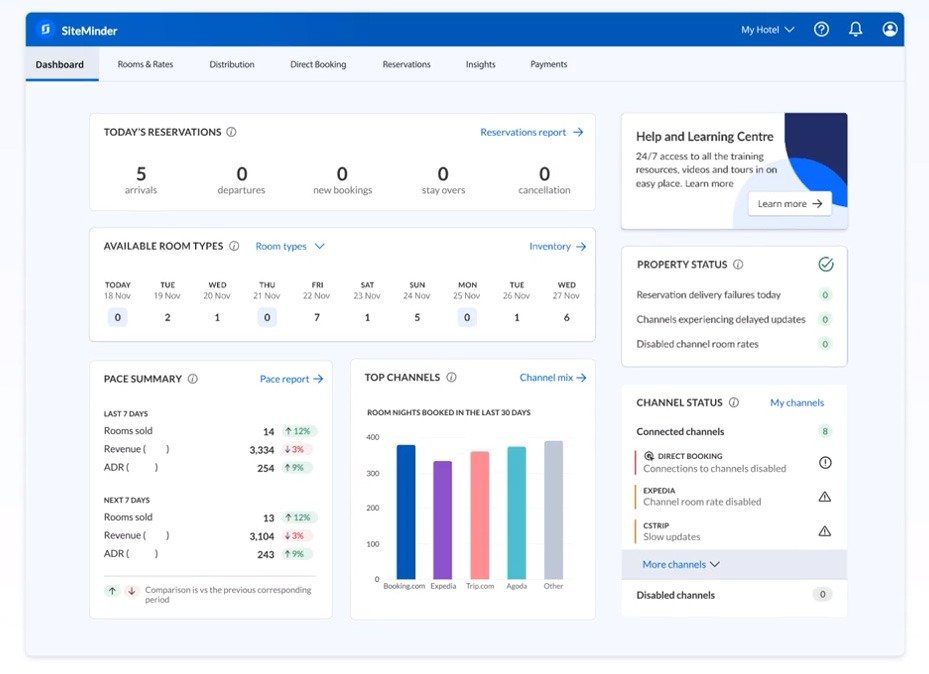
SiteMinder brings a broad set of distribution and revenue tools into one central interface. The main dashboard provides an overview of reservations, availability and performance, while rates and inventory can be managed centrally across connected channels.
The SiteMinder mobile app extends some of that functionality away from the desk. Managers can view performance information, adjust rates and availability, apply stop-sells and make bulk updates from a phone or tablet. It also provides a short-term performance forecast for monitoring upcoming demand.
Initial setup requires properties to connect their PMS and distribution channels and map room types, rate plans, availability and restrictions correctly between systems. This is an important part of any channel-manager implementation: inaccurate mapping can lead to incorrect rates, availability problems or reservations being assigned to the wrong room or rate configuration.
Once the connections are configured, SiteMinder allows rates, availability and restrictions to be managed centrally rather than updated separately through individual OTA extranets. Its pooled-inventory model and PMS integrations are designed to keep availability synchronized as reservations and changes are received through connected channels.
For smaller properties, the amount of setup will depend largely on the complexity of the distribution strategy. A property selling a few room types through several major OTAs may have a relatively straightforward configuration, while hotels working with numerous rate plans, restrictions, channels or market-specific offers will have more to map and maintain.
Channel Manager & Distribution
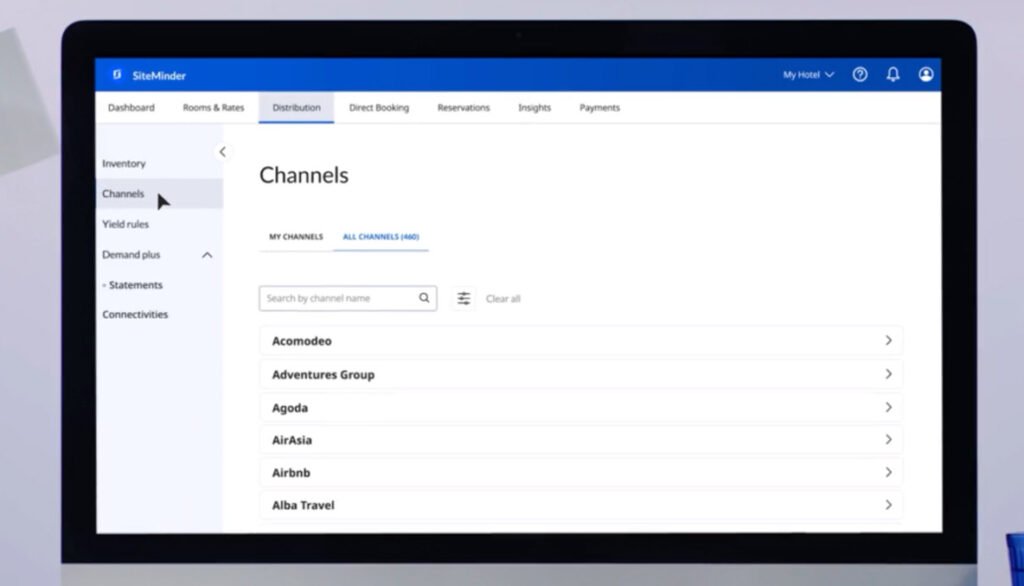
SiteMinder’s Channel Manager is the core of its distribution platform. It connects hotels with more than 450 booking channels, including major OTAs such as Booking.com, Expedia, Agoda and Airbnb, as well as regional channels, wholesalers and other distribution partners.
SiteMinder uses a pooled-inventory model, allowing the same available rooms to be distributed across multiple connected channels rather than dividing inventory into separate allocations. When a reservation is received through one channel, availability is updated across the other connected channels and passed back to the property’s PMS. This reduces the manual work involved in keeping listings synchronized and lowers the risk of accidental overbooking.
Properties can manage rates, availability and restrictions centrally rather than logging into each OTA separately. Depending on the channel and configuration, this can include multiple rate plans, minimum-stay rules, stop-sells and other distribution controls.
Little Hotelier uses SiteMinder’s channel-management technology and now gives smaller properties access to a much broader distribution network than it once did. The distinction is therefore less about whether Little Hotelier can connect to major booking channels and more about the wider level of distribution control and flexibility available through the full SiteMinder platform.
Cloudbeds also offers extensive global distribution, so the number of connected channels alone is no longer enough to distinguish the two platforms. SiteMinder’s particular strength is the role distribution plays at the centre of the wider product, alongside direct booking, metasearch and revenue tools.
For a small independent property, the value of SiteMinder’s broader distribution controls depends on its distribution strategy. A hotel or guesthouse selling through several OTAs or trying to reach different international markets is more likely to benefit from that flexibility than a property relying mainly on direct bookings and one or two major channels.
If you are unsure whether your property actually needs this level of distribution management, see our guide to whether small hotels and B&Bs need a channel manager.
Booking Engine
SiteMinder’s Booking Engine is designed to help hotels take commission-free direct reservations from their own website and other guest-acquisition channels. Properties can add availability search and booking links to their website, while SiteMinder also connects direct rates with metasearch platforms such as Google Hotel Ads, Trivago and Tripadvisor.

Built for a global audience, the booking engine supports multiple languages, currencies and regional tax rules. Hotels can also create rate plans, promotions and promo codes, offer extras such as breakfast or parking, and connect direct-booking availability with the wider SiteMinder distribution setup.
HSG observed two SiteMinder booking-engine implementations as part of its 42-property Hotel Booking Engine Study. Although two observations are too few to characterise every SiteMinder implementation, the two mobile journeys produced very similar results.
Both were easy to navigate on mobile and strong for interface stability. Booking summaries remained visible, guests could easily change or discard their selections, and information organisation was clear. Cancellation terms, rates, taxes and price progression were also clearly presented in both implementations, while alternative currencies were available.
There were some limitations. Both journeys involved a heavy guest-detail/form burden, and progress indicators represented only part of the complete booking journey. Payment reassurance was adequate rather than especially strong, while usable hotel contact and identity information was not maintained throughout the booking environment. Information presentation was also adequate rather than exceptionally polished.
One of the observed booking journeys illustrated an important distinction between the booking engine and the hotel website around it. The property website itself was awkward on mobile, with display and date-selection problems that made reaching the booking engine difficult. Once the guest reached the SiteMinder booking environment, however, the journey worked well. This reinforces HSG’s broader finding that the complete direct-booking experience depends on both the booking-engine technology and the way the hotel website and implementation are configured.
For a small hotel, the observations suggest that SiteMinder can support a stable, well-organised mobile booking journey with particularly clear pricing information and good control over booking selections. The principal friction in the implementations HSG observed came from lengthy guest forms and incomplete progress communication rather than basic mobile navigation.
For context, see HSG’s Hotel Booking Engine Study — Findings.
Compared with Cloudbeds, SiteMinder places greater emphasis on distribution and guest acquisition, while Cloudbeds integrates its booking engine more closely with a wider PMS-led operational platform. Both systems synchronize direct-booking availability with connected distribution channels, so the more meaningful difference is how each platform fits into the property’s wider technology and distribution strategy.
For smaller properties considering Little Hotelier, the difference lies more in operational and distribution complexity than international reach. Little Hotelier can serve international guests through multilingual and multi-currency direct booking and a broad OTA network, while the full SiteMinder platform offers greater scope for properties managing more complex distribution, revenue and guest-acquisition strategies.
In short, SiteMinder’s Booking Engine is a solid option for properties that prioritize global accessibility, rate accuracy, and conversion-focused direct booking over deep visual customization. It works closely with the Channel Manager, helping keep direct-booking availability aligned with the property’s wider distribution setup.
Revenue & Market Intelligence
In a competitive online marketplace where rates can shift quickly across OTAs and direct channels, SiteMinder combines market intelligence with increasingly sophisticated revenue management tools. Its Business Intelligence features provide visibility into property performance, competitor pricing, booking trends, and market demand, while the optional paid Dynamic Revenue Plus add-on takes this a step further with data-driven pricing recommendations and automated dynamic pricing.
Dynamic Revenue Plus analyses signals including your property’s booking patterns, competitor rates, local market demand, and upcoming events to generate daily pricing recommendations. These recommendations are enhanced by revenue management technology from IDeaS and can be reviewed individually or accepted automatically, giving hotels the choice between hands-on rate control and a more automated approach.
That distinction is important because SiteMinder is no longer limited to simply showing hoteliers the data and leaving them to adjust rates manually. With Dynamic Revenue Plus, hotels can enable pricing automation so recommended rates are applied automatically and distributed across connected channels. Automation can be configured by room type with floor and ceiling rates providing additional control over how far prices can move. Hotels can also create overrides for particular dates or periods, such as peak seasons, holidays, or major local events.
For hotels that prefer greater oversight, automation is optional. Revenue managers can instead use the recommendations as decision support, review proposed changes, and action them directly through SiteMinder’s platform or mobile app. This makes Dynamic Revenue Plus particularly flexible: it can operate as an intelligent revenue assistant for hands-on managers or take on more of the repetitive pricing workload where automation is appropriate.
Market intelligence remains a major part of the proposition. SiteMinder combines property performance data with competitor rates, local demand signals, events, booking pace, and broader market information, helping hotels identify dates where demand or pricing conditions may warrant action. Personalised alerts can also surface revenue opportunities through the SiteMinder mobile app, reducing the need for managers to continually monitor reports themselves.
This significantly narrows the revenue-management gap between SiteMinder and platforms offering built-in dynamic pricing. Previously, SiteMinder was easier to characterise as an intelligence platform that required the hotelier—or a connected third-party RMS—to make the actual pricing decision. Dynamic Revenue Plus changes that equation by bringing recommendations, market intelligence, distribution and optional pricing automation into the same SiteMinder environment.
It is still worth distinguishing Dynamic Revenue Plus from a full-scale standalone revenue management system. The add-on brings sophisticated pricing capabilities into the SiteMinder platform without requiring a separate RMS, while properties with more complex revenue-management requirements can still integrate SiteMinder with specialist RMS providers.
Compared with Cloudbeds, which also offers built-in revenue optimisation, SiteMinder now sits much closer to the same category than it once did. The difference is no longer simply automation versus manual control, but how each platform combines pricing intelligence, distribution, and day-to-day revenue workflows.
For smaller hotels and B&Bs, this is arguably one of SiteMinder’s more significant recent improvements. Properties that simply want better visibility can continue using its reporting and market-intelligence tools, while those wanting a more hands-off approach can add Dynamic Revenue Plus and automate selected pricing decisions. The important question for a smaller property is whether that additional sophistication will be used often enough to justify the extra cost.
Guest Engagement
SiteMinder’s Guest Engagement tools extend the platform beyond distribution and direct booking into the guest journey itself. Properties can automate communications before, during and after a stay, offer digital check-in, promote additional services and request feedback without relying entirely on manual follow-up.
Automated messages can be scheduled around different stages of the reservation, while digital check-in allows guests to provide information such as identification, signatures and acceptance of terms before arrival. Hotels can also present personalised upsell offers for extras such as room upgrades, breakfast, early check-in or other services.
SiteMinder also supports digital guest information and post-stay engagement, allowing properties to provide useful stay information and encourage feedback or reviews after departure.
Like Cloudbeds and Little Hotelier, SiteMinder now includes a unified messaging hub that brings guest communications into one place. The Messaging Hub supports email, SMS, WhatsApp, Airbnb and Booking.com messages, allowing staff to manage conversations across several channels without checking separate inboxes.
For a small independent hotel or B&B, the main benefit is reducing repetitive guest communication while creating additional opportunities to sell services around the stay. Properties with a straightforward guest journey may not need every feature, but those handling frequent arrivals, add-ons or pre-arrival communication can bring more of that activity into the same wider SiteMinder environment.
Payments
SiteMinder Pay is the platform’s integrated payment-processing module, allowing properties to manage deposits, guest payments and refunds within the same wider SiteMinder environment. Payment activity is linked to reservations, while a real-time transaction dashboard gives staff visibility over payment status and recent activity.
Properties can create automated payment rules that schedule charges at predefined dates and times, reducing the need to process every transaction manually. SiteMinder Pay also supports payment requests, which can be sent to guests when a payment fails or when additional payment information is required.
For finance and front-desk teams, the main advantage is centralisation. Payments, refunds and reservation information can be managed from the same platform, with transaction reporting available for reconciliation and financial tracking.
SiteMinder Pay is optional rather than essential to the wider distribution platform. Properties can choose whether to use SiteMinder’s own payment-processing tools as part of their setup, depending on their existing payment arrangements and local requirements.
Cloudbeds offers a comparable integrated payment system, while SiteMinder Pay is designed to sit alongside SiteMinder’s direct-booking and distribution tools. For properties comparing the two, the more relevant question is likely to be how well each payment setup fits with the rest of the systems they already use.
For smaller properties, the practical value lies less in sophisticated payment technology than in reducing the number of separate systems staff need to monitor. A hotel or B&B already managing a straightforward payment workflow may see less benefit, while properties processing bookings from several channels may find the centralized transaction view and automated payment rules more useful.
Reporting & Analytics
SiteMinder provides reporting and business-intelligence tools focused strongly on distribution performance, booking trends and market conditions. These reports help hotels understand where bookings are coming from, how different channels are contributing, and how current performance compares with changing demand.
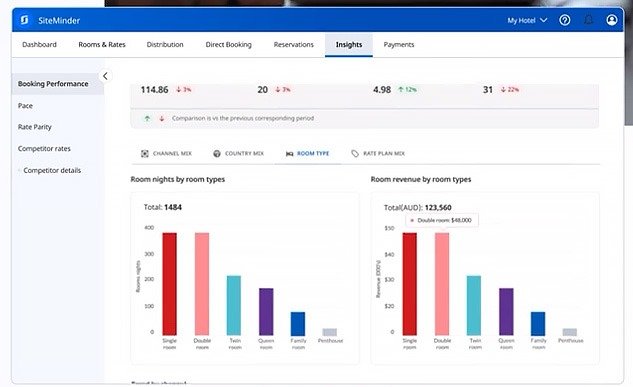
Through SiteMinder’s Business Intelligence tools, hotels can monitor metrics such as occupancy, ADR, RevPAR and booking pace alongside channel contribution and booking-source data. This can help identify over-reliance on particular OTAs, changes in booking patterns or shifts in the property’s distribution mix.
SiteMinder also incorporates market intelligence, including competitor rates, rate-parity monitoring, demand trends and forward-looking booking information. That gives properties a broader view than their own historical performance alone and can support decisions around pricing, promotions and distribution strategy.
Cloudbeds also offers detailed operational and revenue reporting, but SiteMinder’s analytics are particularly closely tied to distribution performance and market intelligence. For properties using several channels, that emphasis can make it easier to assess channel contribution, booking trends, rate parity and changing market conditions alongside the hotel’s own performance.
For a small B&B or guesthouse, some of this detail may be more than is needed day to day. For a boutique hotel or independent property managing several channels, rate plans or international markets, the added visibility becomes more useful as the distribution strategy grows more complex.
Integrations
SiteMinder has a large integration ecosystem, with access to more than 1,500 integrations, apps and industry partners. Connections span property management systems, revenue management, CRM, point-of-sale, payments and other hotel technology.
This flexibility is particularly relevant because SiteMinder is often used as the distribution layer alongside an existing PMS or wider hotel technology stack. Properties can retain specialist systems they already use while connecting rates, availability and reservations through SiteMinder.
Yanolja Cloud Solution takes a somewhat different approach. Its wider eZee ecosystem also separates PMS, channel management, direct booking and revenue management into connected products, while giving properties the option of sourcing more of those functions from the same provider. SiteMinder is particularly suited to hotels that want to retain an existing PMS and build a wider technology stack around its distribution platform.
Large integration marketplaces are no longer unique to SiteMinder. Cloudbeds now offers hundreds of marketplace connections, while Little Hotelier has also introduced an App Store for smaller properties. SiteMinder’s advantage is therefore less about simply offering third-party integrations and more about the scale and breadth of the partner ecosystem around its distribution platform.
For a small independent property, that breadth matters most when there are existing systems or specialist tools that need to remain in place. A B&B using only a straightforward PMS, booking engine and a few major channels may have little need for such a large integration network.
Customer Support & Onboarding
SiteMinder provides 24/7 customer support through chat, phone and email, backed by a global support network and local teams in several major hospitality markets. This is particularly useful for properties selling internationally or working across different time zones.
New customers also receive a dedicated onboarding specialist. Setup typically involves connecting the property’s PMS and booking channels, mapping room types and rate plans, and checking that rates, availability and reservations are flowing correctly between systems. Careful onboarding is particularly important with a distribution platform, where incorrect mappings can create availability or pricing problems later.
Once the system is live, SiteMinder provides online learning resources alongside its ongoing support channels. Larger groups and chains can access more tailored onboarding and premium support as part of SiteMinder’s higher-level offering.
Compared with Cloudbeds, the onboarding emphasis is somewhat different. Cloudbeds guides properties through a broader PMS-led operational setup, while SiteMinder onboarding places particular importance on connecting existing systems and configuring distribution correctly.
Little Hotelier is designed specifically around smaller accommodation businesses and offers a more contained setup experience. The full SiteMinder platform gives properties more scope to build a wider distribution and technology setup, but that also means there can be more connections and configuration decisions to work through.
For a small independent property, 24/7 support and guided onboarding are reassuring features, particularly if online distribution is new territory. Properties with several booking channels or existing hotel systems are also more likely to benefit from having someone guide the initial connections rather than working through the setup entirely alone.
Strengths
Strong channel management and distribution
SiteMinder connects hotels with more than 450 booking channels and remains particularly well suited to properties that depend on broad OTA and international distribution.
Broad guest-acquisition platform
Direct booking, metasearch, distribution and guest engagement now sit alongside the core channel-management tools, giving properties more ways to manage how guests discover and book them.
Large integration ecosystem
SiteMinder connects with more than 1,500 integrations, apps and industry partners, giving hotels considerable flexibility when building around an existing PMS or wider technology stack.
Strong revenue and market intelligence
Business Intelligence provides visibility into booking trends, channel performance, competitor rates and market conditions, while the optional Dynamic Revenue Plus add-on adds pricing recommendations and automation.
Suitable for more complex distribution strategies
SiteMinder can support independent properties as well as larger groups, with its broader controls becoming more useful as the number of channels, rate plans and markets increases.
Strong mobile direct-booking experience
The two SiteMinder implementations observed by HSG were easy to navigate on mobile, stable and well organised, with clear rates, taxes and booking conditions and straightforward control over booking selections.
24/7 support and guided onboarding
Round-the-clock support and dedicated onboarding help properties configure PMS and channel connections correctly and work through distribution issues as they arise.
Weaknesses
Not a full PMS
SiteMinder remains primarily a guest-acquisition, distribution and revenue platform. Properties still need a PMS for operational functions such as room assignment, housekeeping and front-desk workflows.
More configuration for complex setups
Connecting a PMS, mapping room types and rate plans, and configuring several distribution channels requires careful setup. Properties with simple needs may find a more contained system easier to implement.
Advanced features can add to cost
Products such as Dynamic Revenue Plus and other optional services can increase the overall subscription cost, so smaller properties need to consider which parts of the wider platform they will actually use.
Less design flexibility
The booking engine is highly functional, but offers limited customization compared to Cloudbeds’ branded direct booking interface.
Alternatives to SiteMinder
SiteMinder is particularly strong for properties where distribution, guest acquisition and revenue management are central priorities, but several alternatives may suit different operating models.
Cloudbeds
Cloudbeds offers a more tightly integrated all-in-one hospitality platform, combining PMS, channel management, booking engine, guest management and revenue tools. It’s a strong choice for independent and mid-sized hotels that want operations and distribution managed within one ecosystem. SiteMinder’s advantage is less about the raw number of connected channels and more about its broader emphasis on international distribution, metasearch and guest acquisition, while Cloudbeds places greater emphasis on the PMS as the operational centre of the hotel.
Curious how the two compare? See our Cloudbeds vs SiteMinder comparison.
Little Hotelier
Powered by SiteMinder, Little Hotelier is designed specifically for small hotels, inns, guesthouses and B&Bs. It combines PMS, channel management and direct booking in a more contained package, with published pricing and a 30-day free trial making it easier for a small property to evaluate before committing.
Yanolja Cloud Solution / eZee Absolute
Yanolja Cloud Solution offers a broad international hotel-technology ecosystem spanning PMS, distribution, multilingual and multi-currency direct booking, and revenue management. Its modular eZee products allow properties to source several core systems from the same provider, while its pricing can also make it a cost-conscious choice for markets and buyers where software affordability is an important consideration.
ResNexus
ResNexus is particularly well suited to independent hotels, inns, B&Bs and other accommodation businesses wanting an all-in-one system with strong guest-facing features. Alongside PMS, booking and channel management, it includes automated email marketing, text messaging and reputation management, although its distribution capabilities are less central to the proposition than SiteMinder’s.
For hotels comparing these systems, the main question is what they want SiteMinder to replace—or not replace. SiteMinder works particularly well as the distribution, guest-acquisition and increasingly sophisticated revenue management layer around an existing hotel technology stack, while several alternatives place the PMS and day-to-day property operation more firmly at the centre.
Pricing
SiteMinder now publishes a clearer tiered pricing structure for independent properties. Pricing is based on room count, with two main plans: SiteMinder and SiteMinder Plus. Larger groups and chains receive customized pricing through SiteMinder’s sales team.
The standard SiteMinder plan includes the Channel Manager, PMS integration, performance and booking-pace insights, 24/7 support and access to SiteMinder Pay, with transactional fees applying to some services. SiteMinder Plus adds the Booking Engine, hotel website builder, competitor-rate and rate-parity insights, direct-booking plug-in apps and SiteMinder’s Demand Plus metasearch product.
Several more advanced capabilities remain optional add-ons rather than being included automatically. These include Dynamic Revenue Plus, Guest Engagement, GDS connectivity, RMS integrations and multi-property functionality.
For a small independent hotel or B&B, the main pricing question is therefore not simply the monthly subscription. It is whether the standard plan provides enough functionality, or whether direct booking, guest engagement or more advanced revenue-management tools make the higher tier and add-ons worthwhile.
SiteMinder currently offers a 14-day free trial for its independent-property plans, giving hotels an opportunity to explore the platform before committing.
👉 Visit SiteMinder site to view current plans and pricing
Verdict
SiteMinder remains a strong choice for independent and boutique hotels that place a high value on distribution, international reach and guest acquisition. Its channel manager connects properties with more than 450 booking channels, while its direct-booking, metasearch and market-intelligence tools give hotels several ways to reach guests across different markets.
Distribution is still at the centre of SiteMinder, but the platform has expanded considerably beyond its traditional channel-manager role. Guest engagement, payments, business intelligence and the optional Dynamic Revenue Plus add-on now give hotels more tools for managing the journey from attracting a guest through to booking, pricing and pre-arrival communication.
For properties already using a PMS they are happy with, that model can be particularly attractive. SiteMinder can sit around the existing operational system while strengthening distribution, direct booking and revenue management without requiring the hotel to move its day-to-day PMS workflow onto the same platform.
Its international orientation is also significant. Hotels targeting overseas guests can combine broad OTA connectivity with multilingual and multi-currency direct booking, metasearch visibility and access to regional distribution partners. That makes SiteMinder particularly relevant to independent properties whose business depends on reaching guests beyond their immediate domestic market.
For a very small B&B or guesthouse with simple distribution needs, the full platform may offer more capability and configuration than necessary. Little Hotelier or another more contained all-in-one system may be easier to manage. But for an independent hotel working across several channels, markets or rate plans, SiteMinder’s distribution and guest-acquisition focus becomes much more valuable.
The key question is therefore not simply whether SiteMinder is a good channel manager. It is whether distribution and guest acquisition are important enough to your property to justify building a wider part of your technology strategy around them.
⭐ Ease of Use: 4/5
⭐ Distribution & Connectivity: 5/5
⭐ Reporting: 4.5/5
⭐ Value for Money: 4/5
Looking for more options?
See all our hotel booking system reviews and comparisons in the full hub:
Hotel Booking System Reviews (2026)