Last updated September, 2026
For independent hotels, B&Bs, guesthouses, and boutique properties, Cloudbeds offers a broad set of hotel-management tools in one platform. Its core system combines property management, channel management, direct booking, payments, guest communications, reporting, and revenue tools, reducing the need to piece together several separate systems. Cloudbeds currently positions the PMS as the centre of a wider platform that also connects distribution, direct bookings, guest experience, and revenue management.
That breadth is one of Cloudbeds’ main attractions, but it also raises an important question for smaller properties: do you need everything Cloudbeds offers, and is the cost and complexity justified for your operation?
Table of Contents
In this Cloudbeds review, we look at its main features, pricing, strengths and drawbacks, and how well it fits smaller independent properties. We’ll also consider where alternatives such as Little Hotelier, SiteMinder, and eZee Absolute may make more sense.
How we assess hotel software
Hotel Systems Guide considers current product documentation, demonstrations and interface material, independent user feedback where relevant, operational fit and suitability for small independent properties. Read our full review methodology.
👉 You can also compare Cloudbeds with other options in our Best Booking Systems for Small Hotels & B&Bs guide.
Ease of Use & Setup
As with most PMS and channel-management systems, initial setup involves configuring room types, rates, taxes and fees before connecting distribution channels. Cloudbeds then adds further options around payments, direct bookings, revenue tools and guest communications, so properties intending to use the wider platform will have more to configure.
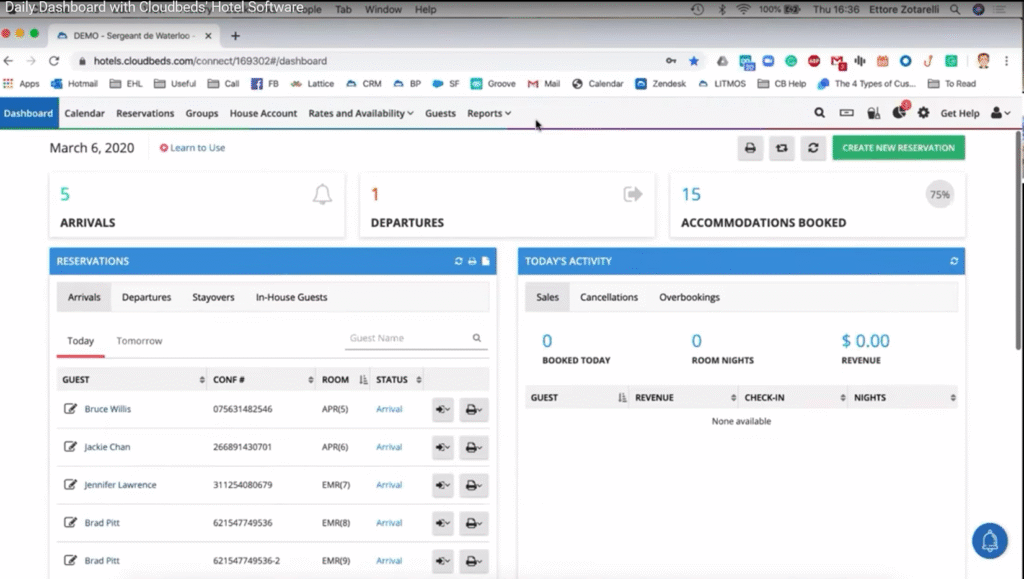
The dashboard brings reservations, guest activity, payments and day-to-day front-desk tasks into one interface. Its calendar-based layout should feel familiar to staff who have used other cloud PMS platforms, although the breadth of Cloudbeds means there is more to configure and learn than with a deliberately simplified system such as Little Hotelier.
Cloudbeds offers both self-service onboarding and guided onboarding with a dedicated coach, along with training through Cloudbeds University. Its published onboarding terms indicate that a typical guided setup takes around two to four weeks, although the actual timeline depends on the property and the amount of configuration or migration involved.
For a small property, that extra setup may be worthwhile if you intend to use Cloudbeds as the central system for distribution, payments, direct bookings and other operations. A very small B&B using only a limited set of Cloudbeds features may have a simpler implementation and can make use of Cloudbeds University and other self-service onboarding resources.
Property Management System (PMS)
Cloudbeds’ PMS forms the operational core of the platform, bringing reservations, housekeeping, guest information, payments and day-to-day front-desk tasks into one system. The calendar provides a visual overview of arrivals, departures and in-house guests, while reservations can be moved or adjusted as plans change.
Guest profiles keep stay and reservation information together, reducing the need for separate records and making it easier for reception and other staff to work from the same information. For a small hotel or guesthouse, that centralized view can be particularly useful when the same few people are handling reservations, check-ins, payments and guest requests.
Cloudbeds also offers an iOS and Android app for mobile access to reservations, guest messages, housekeeping updates, notifications and other front-desk tasks. Properties using supported Cloudbeds Payments features can also accept contactless payments through the app.
Channel Manager
Cloudbeds’ Channel Manager connects the PMS with more than 450 global, regional and niche booking channels, including Booking.com, Expedia, Airbnb and other major OTAs. Rates, availability and restrictions can be managed centrally rather than updated separately in each channel’s extranet.
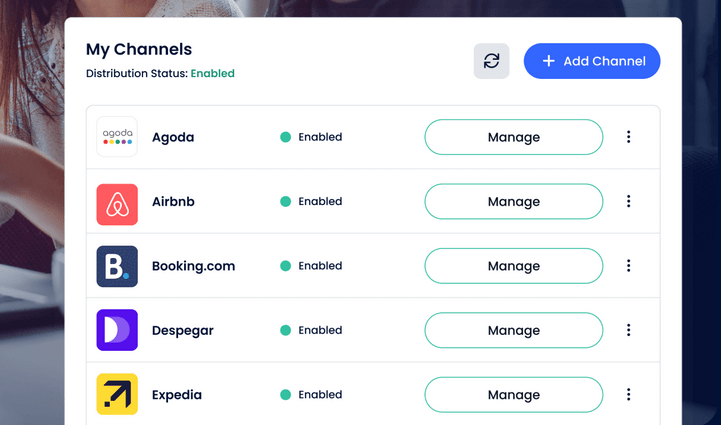
When a reservation is received through a connected channel, inventory is synchronized across the system, reducing the manual work involved in keeping multiple listings up to date and lowering the risk of accidental overbooking.
Cloudbeds also supports more detailed distribution control than a very simple channel manager. Depending on the channel and configuration, properties can work with multiple rate plans, restrictions and channel-specific pricing arrangements from within Cloudbeds rather than managing everything independently on each OTA.
Like Little Hotelier, Cloudbeds has broadened its distribution reach substantially. Little Hotelier now advertises connections to 400+ booking channels, while Cloudbeds lists 450+ global, regional and niche channels. The more meaningful difference for a small property is therefore not simply the number of connections, but how much control each system gives you over rates, restrictions and distribution strategy.
For a small property selling through several OTAs, the main benefit is not the sheer number of available connections but having rates and inventory managed from the same system as reservations and direct bookings. Properties using only one or two channels may place less value on the additional distribution flexibility.
Booking Engine
Cloudbeds’ booking engine is designed to let guests book directly from a property website, with room and rate information feeding into the wider Cloudbeds platform. It supports extras and upsells during the booking journey and connects with the PMS, channel manager and payments tools so direct reservations flow into the same operational system.
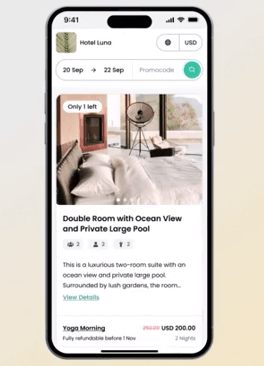
HSG observed three Cloudbeds booking-engine implementations as part of its 42-property Hotel Booking Engine Study. The three mobile journeys were highly consistent in several respects. Room presentation was strong, booking summaries remained visible throughout, changing or discarding booking selections was easy, and cancellation terms, rates, taxes and price progression were presented clearly. All three also retained the hotel’s branding reasonably well while keeping Cloudbeds branding relatively subtle.
The strongest weakness was mobile interaction. All three observed implementations were rated difficult for mobile navigation and difficult overall. In each case, the virtual keyboard covered most of the screen during part of the guest-details stage, making it harder to complete one of the most important steps in the booking journey. The interface also moved rather easily within the browser window, which made the experience feel less stable than the otherwise clear information structure suggested. Friction at this stage can be enough to cause a guest to abandon a booking, although the result should not be assumed to occur on every device. Different phone models and screen sizes, browsers or device settings could produce a different experience.
Progress communication was another weak point: none of the three implementations showed a meaningful overall progress indicator. By contrast, secure-payment reassurance was clear, recognizable payment methods were present, and hotel identity/contact information remained available.
The result was an interesting contrast: the observed Cloudbeds booking engines were strong on information clarity, room presentation and booking control, but weaker in the mobile interaction itself. For hotels evaluating Cloudbeds, it would therefore be worth testing the booking flow on a real smartphone rather than relying only on desktop previews.
For a small independent property, the practical advantage is that direct reservations, extras and payments can feed into the same system as PMS and channel bookings rather than requiring separate availability management. The degree of visual continuity between the hotel website and booking process will depend partly on how the property chooses to implement the engine.
For context, see HSG’s Hotel Booking Engine Study — Findings.
Dynamic Pricing & Rate Intelligence
Cloudbeds now offers Revenue Intelligence, powered by Signals AI, as its advanced revenue-management layer. It combines property performance data with market and competitor information to forecast demand, recommend room rates and, where configured, automate pricing decisions.
The system can take account of factors such as:
- occupancy and booking pace
- competitor rates
- market demand
- local demand drivers
- historical and forward-looking property data.
For smaller properties without a dedicated revenue manager, the appeal is straightforward: instead of repeatedly checking competitor prices and deciding when to change rates manually, the system can surface pricing opportunities and automate some of those decisions.
Cloudbeds is no longer unusual in offering this type of functionality. Yanolja’s eZee Mint has developed into a dedicated dynamic-pricing tool of its own, using factors including occupancy, competitor-set analysis, seasonality, lead time and demand, while Little Hotelier now offers competitor and market pricing intelligence through Dynamic Revenue Plus.
Where Cloudbeds stands out is in how deeply its revenue tools are being integrated into the wider platform, with Signals increasingly combining PMS, market and demand data rather than functioning simply as a rate-shopping tool. For a small independent property, however, the more important question is whether that additional sophistication will actually be used — especially if advanced revenue functionality increases the overall cost.
Tip: If you’re interested in a broader look at how small hotels use pricing automation, see our guide on dynamic pricing for small hotels.
Guest Communication & Automation
Cloudbeds’ Guest Experience tools bring guest communications from multiple channels into a unified inbox within the PMS. Staff can manage email, SMS, WhatsApp and messages from major booking channels such as Booking.com and Airbnb without moving between separate inboxes.
Automated messages can be scheduled around different stages of the guest journey, including pre-arrival and post-stay communication, while guest information and messaging history remain connected to the reservation. Cloudbeds also supports personalized offers and upselling as part of its wider guest-experience tools.
For a small hotel or guesthouse, the practical advantage is less about sophisticated marketing automation than simply having fewer places for a small team to monitor. Messages arriving through different channels can be handled from one workspace rather than checked separately throughout the day.
Like Cloudbeds, Little Hotelier now offers a unified messaging hub, including email, SMS, WhatsApp, Airbnb and Booking.com. The distinction between the two is therefore less about whether centralized guest messaging exists and more about the breadth of the surrounding platform and automation available.
SiteMinder remains particularly strong in distribution, but it too has expanded further into guest engagement, including messaging, digital check-in and upselling. Cloudbeds’ differentiation is increasingly the degree to which these functions sit alongside PMS operations, guest profiles, reservations and revenue tools within the same wider platform.
Payments & Financial Reporting
Cloudbeds Payments is integrated directly with the PMS, allowing properties to take online and in-person payments while keeping transactions linked to the corresponding reservation. It supports major cards and, where available, digital wallets such as Apple Pay and Google Pay. Cloudbeds Payments is PCI DSS Level 1 certified and uses security measures including tokenization, encryption and 3D Secure authentication.
For managers, payment activity sits alongside reservations and financial reporting rather than being managed in a completely separate system. Cloudbeds provides transaction, payout and statement reporting, which can simplify reconciliation for properties using Cloudbeds Payments as their main processor.
Integrated payments are no longer unique to Cloudbeds. Little Hotelier also links deposits, payments and refunds with reservations and records transactions for bookkeeping and reconciliation. The stronger argument for Cloudbeds is therefore not simply that it has a polished payments interface, but that payments form part of a broader operational and reporting platform.
Reporting & Analytics
Reporting is one of the areas where Cloudbeds offers considerably more depth than a very lightweight small-property system. Core reports cover metrics such as occupancy, ADR, RevPAR and revenue, while additional reports can be used to examine booking pace, future occupancy and financial performance. Cloudbeds has also continued to update its finance and occupancy reporting, including changes introduced in late 2025.
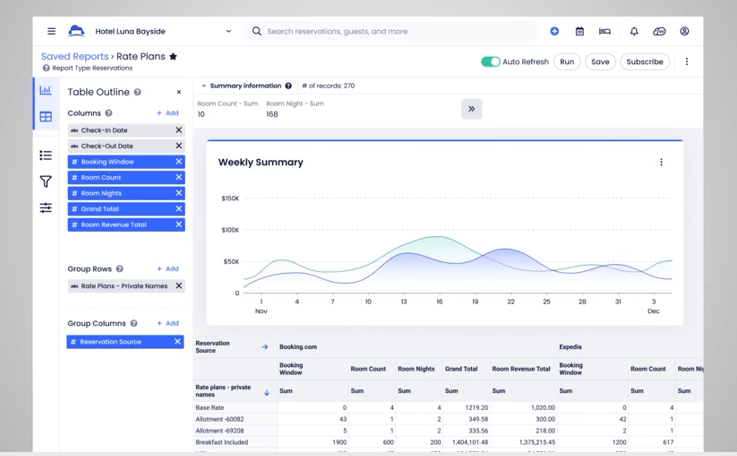
Compared to Little Hotelier, Cloudbeds provides a broader reporting environment for properties that want to analyze performance across multiple operational and revenue dimensions. You can segment data by channel, date range, room type, or rate plan.
For a small B&B, some of that depth may be unnecessary. For a boutique hotel, busier independent property or growing operator, the additional reporting becomes more useful as there are more channels, rate plans and operational decisions to monitor.
Customer Support & Onboarding
Cloudbeds provides 24/7 customer support, including live chat and email, with phone support also available. It describes its support as multilingual, which is relevant for properties operating outside English-speaking markets.
As mentioned earlier, guided onboarding includes a designated onboarding coach who works with the property during implementation and helps configure the account around its operations. Cloudbeds also provides self-service training through Cloudbeds University, including on-demand courses, videos and other learning resources.
Properties wanting more hands-on training can purchase additional live sessions through Cloudbeds University, including one-to-one training and broader overview sessions.
For smaller properties, the value of this structured onboarding depends partly on how much of the Cloudbeds platform they intend to use. A simple property using only core PMS and distribution functions may need less guidance, while a hotel configuring payments, guest communication, revenue tools and multiple channels is more likely to benefit from the additional support.
Integrations & Marketplace
Cloudbeds has a broad integration ecosystem, with 400+ marketplace integrations spanning areas such as revenue management, guest experience, accounting, point-of-sale systems, access control and other hotel operations.
Available integrations include tools for:
- revenue management and dynamic pricing
- CRM and guest engagement
- keyless entry and smart locks
- point-of-sale systems
- accounting and financial tools
- operational and guest-experience applications.
Apps can be discovered through the Cloudbeds Marketplace, with supported integrations connecting third-party tools directly to the PMS. Cloudbeds also provides an Open API, which gives larger or more technically ambitious operators additional scope to build custom connections.
Little Hotelier has also expanded beyond core OTA and payment connections and now offers its own App Store for third-party integrations. Cloudbeds’ advantage is therefore less about simply having an integration marketplace and more about the breadth of its ecosystem and the amount of flexibility available to properties building a more complex technology stack.
For a small B&B using only the core PMS, booking engine and channel manager, hundreds of integrations may not add much immediate value. For a growing boutique hotel or independent property wanting to add specialist revenue, access, POS or guest-experience tools over time, the larger ecosystem becomes much more relevant.
Strengths
- Broad all-in-one platform: Combines PMS, booking engine, channel management, payments, guest communication, reporting and revenue tools within one wider ecosystem.
- Strong revenue-management capability: Cloudbeds Revenue Intelligence combines property data, competitor rates and market-demand signals to support rate recommendations and automated pricing.
- Good fit for properties with growing operational complexity: The platform can support a single independent property while also offering tools, integrations and APIs that become more useful as operations expand.
- Extensive integration ecosystem: Cloudbeds now cites more than 400 marketplace partners, alongside an Open API for custom connections.
- Detailed reporting and analytics: Offers considerably more reporting depth than many deliberately simplified small-property systems.
- Strong booking information and room presentation
In the three Cloudbeds booking engine implementations observed by HSG, room presentation, pricing, cancellation terms, taxes and booking summaries were consistently clear. The main weakness was not the information itself, but how comfortably the booking flow behaved on mobile.
Weaknesses
- More setup and learning than simpler systems: The breadth of the platform means there is more to configure and understand, particularly for properties using payments, revenue management, guest experience tools and multiple integrations.
- Pricing is not transparent: Cloudbeds does not currently publish standard monthly prices, so properties need to request a quote and compare the cost of the particular package and additional products they need.
- May be more platform than a very small property needs: For a small B&B or guesthouse with straightforward requirements, the combination of quote-based pricing, implementation effort and a broad feature set can make Cloudbeds harder to evaluate than simpler systems with transparent plans and a narrower scope.
Alternatives to Cloudbeds
Little Hotelier – Better suited to very small properties that want a simpler system and more transparent pricing. It now offers broader distribution, messaging, payments and revenue tools than it once did, so the gap with Cloudbeds is narrower than before. Cloudbeds still offers more depth and extensibility, while Little Hotelier remains easier to evaluate for a small B&B or guesthouse because pricing is shown according to room count and there is a 30-day trial.
If you’re deciding between the two, check out our comparison article Cloudbeds vs Little Hotelier comparison.
SiteMinder – A strong alternative for properties where distribution and guest acquisition are especially important. SiteMinder now spans channel management, booking engine, guest engagement, payments and wider hotel-commerce tools. Its current platform connects hotels with 450+ distribution channels.
If you’re comparing the two, see our Cloudbeds vs SiteMinder comparison.
Yanolja Cloud Solution / eZee Absolute – A strong alternative for independent properties that want broad PMS, distribution and revenue-management functionality with an international focus. Its wider ecosystem, including eZee Mint for dynamic pricing, makes it a much more capable option than the old “budget alternative” label suggests.
ResNexus – Particularly relevant to B&Bs, inns, boutique lodging and outdoor-hospitality businesses. Its strengths include built-in guest communication, direct booking, OTA connections and a growing integration ecosystem, with a stronger North American orientation than the other alternatives covered here.
Lodgify – For smaller owner-managed properties that prioritise direct bookings and an easy-to-manage website, see our Lodgify Review (2026).
For help comparing systems side by side, see How to Choose the Right Hotel Management System — or download the Hotel System Evaluation Workbook to score your shortlist against your property’s needs.
Pricing
Cloudbeds does not currently publish standard monthly prices. Instead, properties are asked to request a quote based on their requirements, with pricing structured around different plans and the products they choose to use.
That makes Cloudbeds harder to compare at a glance with systems such as Little Hotelier that publish pricing more openly. For a small B&B or guesthouse, the extra step of requesting a quote and discussing requirements may itself be a consideration when evaluating whether the broader Cloudbeds platform is necessary.
Cloudbeds is designed to let properties start with the functionality they need and add further tools over time. Some capabilities, including certain booking-engine enhancements, guest-experience features and other specialist products, depend on the subscription package or require an upgrade.
Pricing takeaway: Cloudbeds may suit properties that value a broad, integrated platform, but the lack of published pricing makes it difficult for smaller operators to judge value without first entering the sales process.
👉 Visit Cloudbeds site to view current plans and request pricing
Verdict: Is Cloudbeds Worth It?
Cloudbeds is one of the more comprehensive hotel-management platforms available to independent properties. It combines PMS, distribution, direct booking, payments, guest communication, reporting and increasingly sophisticated revenue-management tools within one wider system.
For an independent hotel or boutique property managing several channels and looking to centralize more of its operation, that breadth can be a real advantage. Cloudbeds is particularly compelling where a property expects to make use of its stronger reporting, revenue tools, integrations and automation rather than simply needing a basic PMS and channel manager.
For a very small B&B or guesthouse with straightforward requirements, the decision is less clear. Cloudbeds requires more evaluation and configuration than simpler systems, and its lack of published pricing makes it difficult to judge value without requesting a quote. A smaller property may therefore find a more transparent, streamlined platform easier and less time-consuming to evaluate and adopt.
The key question is not whether Cloudbeds has enough functionality — it almost certainly does. It is whether your property will use enough of that functionality to justify the additional complexity and unknown cost.
⭐ Ease of Use & Setup: 3.5/5
⭐ Mobile Optimization: 4/5
⭐ Reporting: 4.5/5
⭐ Value for Money: Not rated — pricing by quote
Looking for more options?
See all our hotel booking system reviews and comparisons in our Hotel Booking System Reviews hub.