Last updated September, 2026
For small hotels, B&Bs, and inns, running daily operations can feel overwhelming. Between juggling OTA commissions, handling guest communications, and keeping track of housekeeping, independent hoteliers often need a system that simplifies rather than complicates.
Little Hotelier is a well-known booking systems created specifically for small properties. Unlike enterprise platforms built for large hotel chains, it focuses on ease of use, mobile-first booking, and essential tools to save time and increase direct bookings. In this Little Hotelier review, we’ll break down its features, strengths, weaknesses, pricing, integrations, and how it compares to alternatives.
How we assess hotel software
Hotel Systems Guide considers current product documentation, demonstrations and interface material, independent user feedback where relevant, operational fit and suitability for small independent properties. Read our full review methodology.
Table of Contents
👉 For an overview of all the top booking systems in 2026, see our guide: Best Booking Systems for Small Hotels & B&Bs.
Ease of Use & Setup
One of Little Hotelier’s biggest advantages is how quickly small hotels can get started. Many small properties are able to complete the self-service setup and begin using the system within a day, while customers who prefer more guidance can use specialist-assisted onboarding.
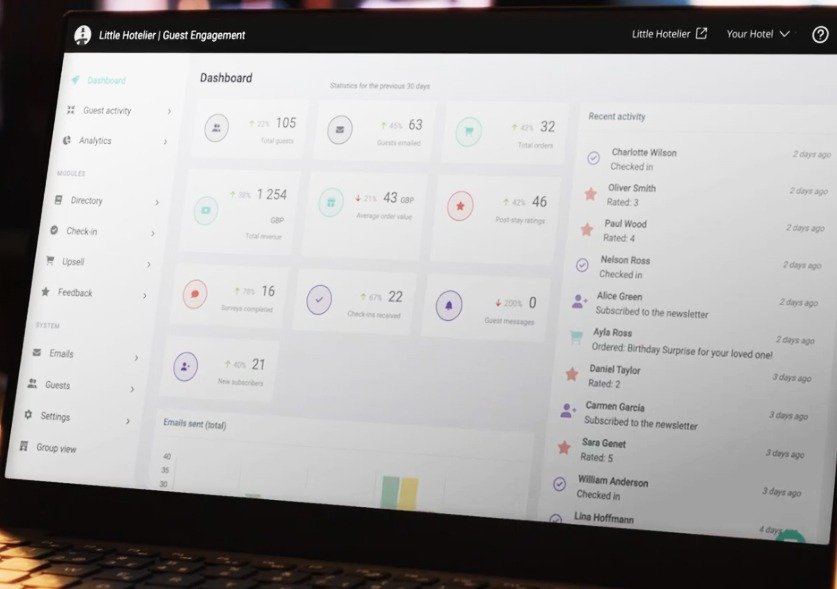
For hoteliers moving from spreadsheets or manual OTA updates, the learning curve is relatively gentle. Compared to Cloudbeds, which offers more advanced reporting but may require a longer onboarding process, Little Hotelier is designed for speed and simplicity. SiteMinder offers much broader distribution capabilities, but unless distribution is a major strategic priority, Little Hotelier may be simpler for a property managing only a handful of rooms.
The trade-off is flexibility — advanced users may find the setup less customisable than enterprise systems. But for B&Bs and inns, the time saved on setup and daily operations often outweighs the need for complex configurations. With the Little Hotelier mobile app, small-property owners can also view reservations, manage availability, and check guests in or out from their phone.
Property Management System (PMS)
At its core, Little Hotelier includes a built-in Property Management System (PMS) designed specifically for small properties. Unlike many larger hotel PMS tools that require formal training, this one is intentionally lightweight — focused on the daily essentials rather than enterprise operations.
You can manage reservations, check-ins, check-outs, and housekeeping status directly from the dashboard. The calendar view gives instant visibility of room availability, and colour-coded bookings make it easy to spot gaps and booking patterns.
Guest details, payment history, and booking source are stored automatically, so even small teams can track repeat visitors or handle last-minute changes efficiently.
Because the PMS is fully integrated with Little Hotelier’s booking engine and channel manager, you don’t have to sync data manually — availability updates happen in real time across your website and OTAs.
The simplicity has a trade-off: fewer customization options compared to full-scale PMS platforms like Cloudbeds or eZee Absolute. But for owner-managed B&Bs, that’s usually an advantage — it keeps daily tasks quick, visual, and helps reduce manual errors.
Mobile-First Booking Engine
Little Hotelier includes a direct-booking engine designed to work alongside its PMS and channel manager, so reservations made through the hotel website feed into the same inventory used for other sales channels.
HSG observed four Little Hotelier implementations as part of its 42-property Hotel Booking Engine Study. Although the study assesses individual hotel implementations rather than assuming that every characteristic comes from the underlying platform, the four Little Hotelier mobile booking journeys showed several notably consistent patterns.
All four were easy to navigate on mobile and were rated strong for interface stability and strong for room presentation. In each case, the developing booking summary remained persistently available, and guests could easily change their booking choices, discard a selected room and move backwards through the journey. Brand and ambience were also retained in all four implementations, despite the booking process moving into a separate booking environment.
There were, however, some limitations. All four presented guests with rather lengthy form-filling, as well as a limited progress indicator rather than one that clearly represented the entire booking journey. Usable hotel contact and identity information could also have been more visible throughout the booking process, reinforcing both brand continuity and trust. Tax and fee visibility was another area that could have been clearer in all four cases we observed.
When it came to cancellation and payment information, however, the Little Hotelier booking engine could present clear, coherent information that was readily accessible to the guest without requiring them to complete the lengthy personal-detail form first. That form burden was one of the main factors preventing the observed Little Hotelier journeys from being rated easy overall.
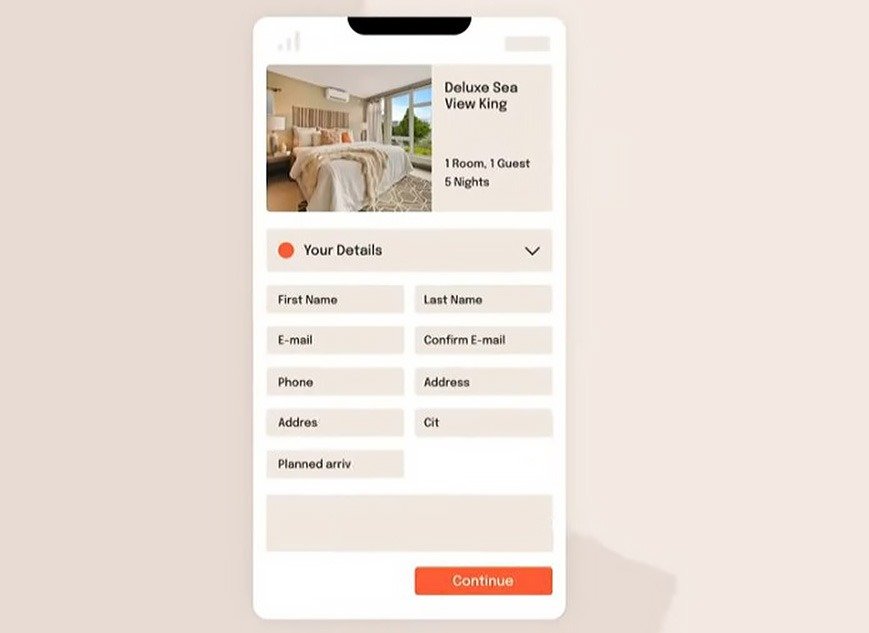
For a small hotel, B&B or inn, the observations suggest that Little Hotelier can support a stable, straightforward mobile booking journey with strong room presentation and good control over booking selections. The more important implementation questions may be how much information the hotel asks guests to enter, how clearly progress is communicated, and how well cancellation, payment and contact information are configured.
For context see HSG’s Hotel Booking Engine Study — Findings.
Channel Manager
Double-bookings and mismatched rates are a major headache for small hotels. Little Hotelier’s built-in channel manager synchronises availability and rates across more than 450 local, niche and international booking channels, including Booking.com, Expedia and Airbnb. If a guest books through one channel, the room inventory is updated across the others and the hotel’s direct-booking system.
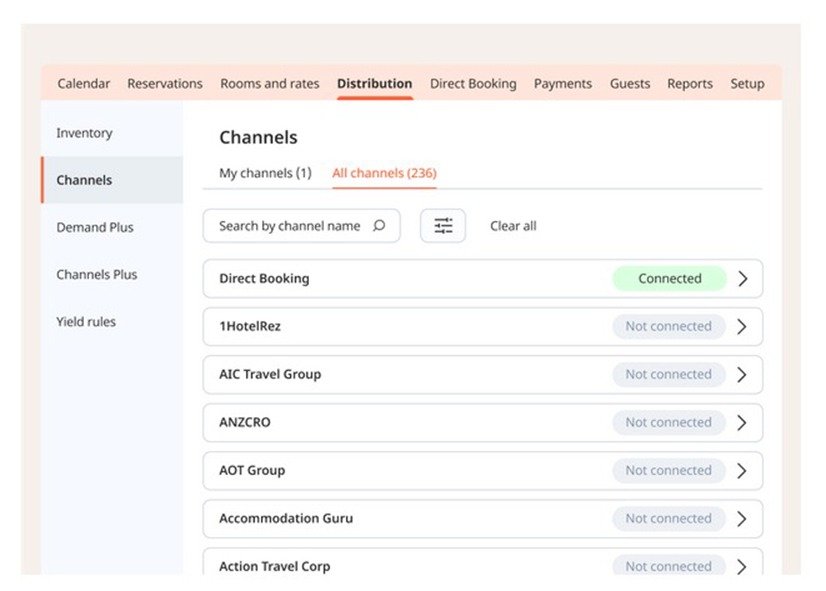
This automation saves owners from updating each channel manually and reduces the risk of overbookings. Rate and availability changes can be managed centrally and distributed across connected channels, while availability controls and different room-and-rate strategies give properties more control over where inventory is sold.
The channel manager distributes pricing changes, but automated yield management is available through Little Hotelier’s separate Dynamic Revenue Plus add-on. This uses property and market data to recommend rates and can apply pricing updates automatically or leave the owner to approve them manually.
If you’re comparing rate rules vs full dynamic pricing, our guide on dynamic pricing for small hotels explains the difference clearly.
Compared with Cloudbeds and SiteMinder, Little Hotelier keeps channel management relatively straightforward. SiteMinder provides more advanced distribution tools for properties where channel reach and distribution strategy are major priorities, while Cloudbeds offers broader operational and revenue-management capabilities. Yanolja Cloud Solution’s eZee ecosystem provides similar core functionality, but its interface and workflow feel less polished.
For independent hoteliers, Little Hotelier strikes a useful balance: broad enough to support a diversified distribution strategy, yet simple enough for a small team to manage.
Guest Communication Tools
Good communication improves the guest experience and reduces administration. Little Hotelier’s Guest Engagement tools bring conversations from email, SMS, WhatsApp, Airbnb, and Booking.com into a single inbox, so staff do not have to move between different platforms to keep track of guest enquiries and messages.
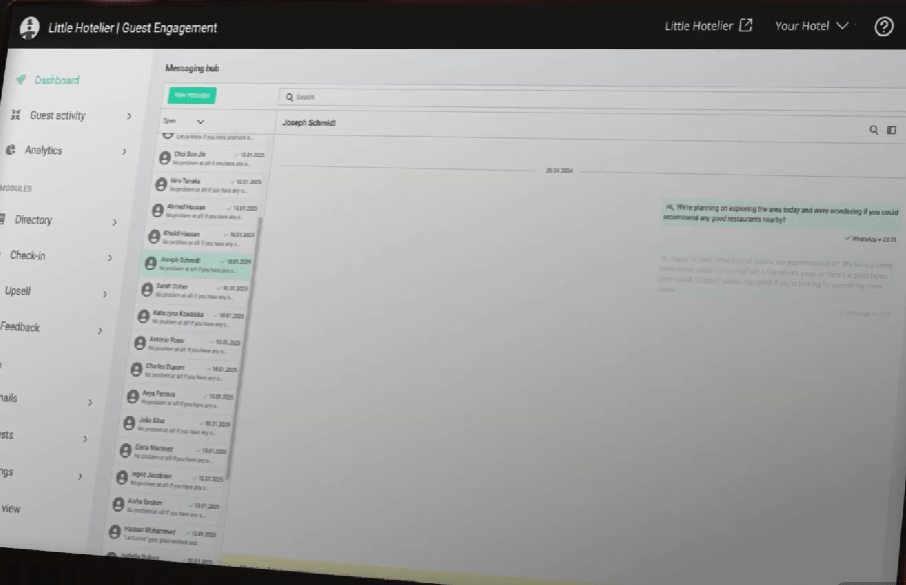
Properties can also schedule communications such as booking confirmations, pre-arrival information, welcome messages, and post-stay follow-ups. Personalised messages can include offers such as breakfast, parking, room upgrades, or late checkout, helping small properties generate additional revenue without requiring a separate marketing system.
Cloudbeds offers a broader guest-experience platform, combining multichannel messaging with features such as campaigns, surveys, guest profiles, and a dedicated upsell store. Little Hotelier’s approach is more streamlined, but its unified inbox and message automation should cover the main communication needs of many B&Bs, inns, and small hotels.
Guest Engagement also includes tools for collecting pre-arrival details, sharing digital guest information, and requesting feedback after the stay.
Payments & Invoicing
Little Hotelier includes secure, PCI-compliant payment processing as part of its standard setup. Guests can pay online using major credit cards and other supported payment methods, with transactions handled through Little Hotelier’s integrated payment tools. This ensures a smooth booking experience for travelers while reducing the risk of no-shows for property owners.
For hoteliers, the system also generates invoices and simplifies reconciliation, removing the need to juggle separate accounting tools. Payments and bookings sync seamlessly with the property’s schedule, so staff always have a clear overview of confirmed reservations.
Compared with Cloudbeds, which offers a broader financial-reporting environment, Little Hotelier keeps payment management more focused on the needs of smaller properties. Yanolja Cloud Solution’s eZee ecosystem also supports integrated online payments and multiple payment options, but its wider payment setup depends on the combination of eZee products and payment integrations a property chooses to use. For B&Bs and small hotels, Little Hotelier offers a straightforward payment setup that may suit properties wanting fewer moving parts.
Reporting & Insights
Little Hotelier provides straightforward reporting on occupancy, revenue, and performance trends. These snapshots help small-property owners track growth, identify busy periods, and plan staffing or rate changes.
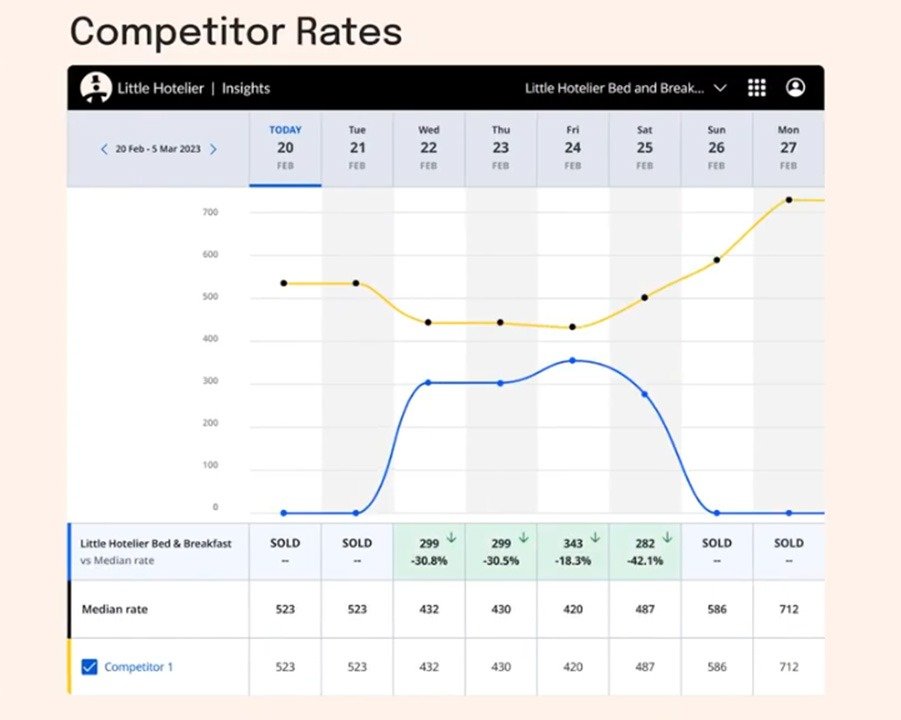
Little Hotelier Insights also allows properties to compare their rates with up to 10 competitors, monitor pricing trends up to 90 days ahead, and check how their own rates appear across direct and third-party channels. Channel-performance reports can help owners see which room types, rate plans, markets, and booking channels are producing the strongest results.
The trade-off is depth. Larger systems like Cloudbeds offer more detailed analytics and financial reporting. For very small properties, though, Little Hotelier’s streamlined reports may be sufficient — they highlight practical pricing and distribution opportunities without overwhelming staff with data they may not use.
If your priority is quick visibility into occupancy, revenue, competitor pricing, and channel performance, Little Hotelier delivers. If you need complex financial analysis or advanced revenue management, you may eventually outgrow it.
Customer Support & Training
One of the reasons Little Hotelier appeals to small-property owners is its emphasis on accessible support and self-guided learning. Its Help Centre is divided between the newer Platform Experience and the Classic Experience, so customers can find guidance that matches the version of the system they use.
Both resource sections contain a substantial collection of setup guides, tutorials, product tours, and step-by-step help articles. Little Hotelier says customers have access to more than 500 Help Centre articles and quick tutorials, which should allow many owners to solve routine questions without waiting for assistance.
Direct support is also available through live chat, email, and regional phone lines, with 24-hour English-language support advertised in several markets. Customers who prefer to set up the system independently can use the online guidance and product tours at no additional cost, while specialist-assisted onboarding is available as a paid option.
This combination of detailed self-service resources and direct assistance is particularly valuable for B&Bs, inns, and small hotels without an in-house IT team. Larger platforms may offer more formal training programmes, but Little Hotelier’s support model is designed to help small-property owners become confident with the system without making implementation unnecessarily complex.
Integrations
Little Hotelier connects with the main services small properties need to manage reservations and distribution. Its channel manager links with major OTAs such as Booking.com, Expedia, Airbnb, and Agoda, as well as a much wider range of local, niche, and international booking channels. Rates, availability, and reservations are synchronised in real time, reducing manual updates and the risk of overbookings.
Little Hotelier Pay is integrated with the booking system, allowing payment details and transaction status to remain connected with the relevant reservation. Confirmed bookings also flow directly into the PMS and daily calendar without duplicate entry.
The platform can also connect properties with metasearch services such as Google Hotel Ads, Tripadvisor, and Trivago, although availability may depend on the selected plan or add-on.
Little Hotelier’s wider third-party integration ecosystem is less extensive than SiteMinder’s or Cloudbeds’. However, many of the essential functions are built into the platform rather than requiring separate applications, which may be an advantage for small properties that prefer a simpler technology setup.
Overall, Little Hotelier prioritises a closely integrated core system over a very large marketplace of specialist apps. That should suit many independent hotels, B&Bs, and inns, although properties requiring particular accounting, revenue-management, CRM, or operational integrations should confirm availability before subscribing.
Strengths
Quick setup and ease of use
Many small-property owners highlight how fast they can get up and running with Little Hotelier. Setup often takes less than a day, and the clean interface means even non-technical staff can manage it without training.
Designed for small hotels and B&Bs
Unlike enterprise platforms that try to serve everyone, Little Hotelier is built specifically for independent properties. Its streamlined tools are tailored to the daily realities of B&Bs, inns, and small hotels, including a single inbox for managing guest conversations from email, SMS, WhatsApp, Airbnb, and Booking.com without switching between separate platforms.
Mobile-first booking engine
The observed Little Hotelier booking journeys were consistently easy to use on mobile, with stable layouts that sat neatly within the browser window and were straightforward to navigate. Room presentation was strong. The main friction came from the amount of form-filling rather than from the mobile interface itself.
Integrated channel manager with broad distribution
Little Hotelier connects properties with more than 450 major, local, and niche booking channels while keeping rates and availability synchronised in real time. This reduces the risk of double-bookings and allows owners to manage distribution from one dashboard rather than updating multiple channels separately.
Reliable customer support
Users consistently note responsive phone and email support. For small hotels without IT departments, having accessible help is a key advantage.
Weaknesses
Limited reporting
While occupancy and revenue reports are available, Little Hotelier doesn’t provide the advanced analytics that larger systems like Cloudbeds offer. Properties that want deep revenue insights may find it lacking.
Less suitable for larger properties
Little Hotelier shines for small hotels, but it doesn’t scale as well for operators managing multiple properties or larger hotels with complex needs.
Higher cost compared to budget competitors
At around $109/month, it’s more expensive than budget options like eZee Absolute. For some owners, the simplicity justifies the price, but for others, cost may be a concern.
Smaller third-party app ecosystem
Little Hotelier offers broad booking-channel connectivity, but its wider ecosystem of specialist third-party software integrations is less extensive than those of platforms such as SiteMinder and Cloudbeds. Properties requiring particular accounting, CRM, revenue-management, or operational tools should confirm compatibility before subscribing.
Alternatives to Little Hotelier
While Little Hotelier is an excellent fit for many small hotels and B&Bs, it is not the only option. The following alternatives may be more suitable where a property needs greater analytical depth, a lower price, more advanced distribution, or a different approach to guest management.
Cloudbeds
Cloudbeds is a broader, more feature-rich platform for independent hotels, boutique properties, and growing accommodation businesses. It combines operations, distribution, guest experience, payments, and revenue intelligence in one system, with more advanced reporting, pricing, and upselling capabilities than Little Hotelier. The trade-off is greater complexity, so smaller owner-managed properties may face a longer learning curve and more involved onboarding.
If you’re interested in Little Hotelier and Cloudbeds, take a look at our Cloudbeds vs Little Hotelier: Best for Small Hotels & B&Bs comparison article.
Yanolja Cloud Solution / eZee Absolute
For owners on a tighter budget, Yanolja Cloud Solution provides a more affordable all-in-one alternative, including a cloud PMS, booking engine, channel manager, and mobile app. Its range of operational features is substantial, but the interface and workflows may feel less smooth than Little Hotelier’s. It is worth considering when price and breadth of functionality matter more than having the simplest possible experience.
For an in-depth comparison, see our article Little Hotelier vs eZee absolute (2026): Which Is Better for Small Hotels and B&Bs?.
SiteMinder
SiteMinder is a strong alternative for hotels where distribution is a major strategic priority. It combines access to more than 450 booking channels with metasearch, GDS connectivity, rate and revenue tools, and broader controls for managing demand across markets. For a very small property seeking a straightforward all-in-one system, this may be more capability than is necessary; for hotels with complex distribution requirements, it offers considerably greater depth.
ResNexus
ResNexus remains particularly relevant to inns, B&Bs, and other independent lodging businesses in North America. It places strong emphasis on guest communication, automated marketing, direct upsells, repeat-business tools, and detailed operational reporting. Properties outside North America, or those relying heavily on international distribution, should confirm that its channel connections, payment options, localisation, and support coverage meet their particular requirements.
Lodgify
Properties wanting a stronger website-builder and vacation-rental crossover may also want to consider our Lodgify Review (2026).
If you’re comparing systems tailored to B&Bs and inns, see our ResNexus vs Little Hotelier guide.
Pricing
At the time of writing, Little Hotelier presents two available options for US customers: Pro and a limited-time Revenue Optimiser offer. Both are advertised from $119 per month, although final pricing may depend on factors such as property size, location, tax, and any optional services selected.
Pro includes the core Little Hotelier platform, broader support, and setup with an onboarding specialist. Revenue Optimiser includes the Pro features together with Dynamic Revenue Plus. Under the current promotion, no booking fees apply for the first three months; booking fees begin after that introductory period. The promotional terms apply for 12 months from signup, after which the standard fee arrangement may change.
Although a Basics plan still appears in some Little Hotelier pricing material, it was shown as unavailable when checked from the US. Availability therefore appears to vary by market or current sales policy, so prospective customers should confirm which plans can actually be purchased in their location.
Both visible plans include specialist-assisted onboarding, but Little Hotelier notes that plans using an onboarding specialist may incur a setup fee depending on the products or add-ons chosen. Payment-processing charges and fees for optional services may also apply.
Little Hotelier offers monthly payment without a long-term contract, and annual payment may qualify for a discount. A free trial is available before the paid subscription begins.
At $119 per month, Little Hotelier is not the cheapest option for a very small property. Its value rests on the integrated system, straightforward workflows, broad distribution, support, and onboarding rather than on being a budget product.
Little Hotelier’s pricing structure has changed over time, and some plans may appear in pricing information that is not currently available in all markets. Prospective customers should confirm the available options and current pricing for their location before subscribing.
👉 Visit Little Hotelier site to learn more
Verdict: Is Little Hotelier Worth It?
Little Hotelier remains one of the strongest options for small hotels, B&Bs, and inns that want an integrated system without the complexity of larger hotel platforms.
Its biggest strengths are still ease of use and simplicity, but the platform has expanded considerably. The channel manager now provides access to a much broader distribution network, while the unified guest communication inbox helps small teams manage conversations across multiple channels without switching between systems.
The booking engine, PMS, payments, reporting, and guest-engagement tools work together in a way that suits owner-managed properties where time and simplicity matter.
The main trade-off is that larger platforms such as Cloudbeds and SiteMinder provide deeper analytics, more extensive integrations, and more advanced tools for properties with complex operational or distribution needs.
For small independent properties that want to save time, increase direct bookings, and reduce manual administration, Little Hotelier offers a strong balance between capability and ease of use.
Best suited for:
- Small hotels and B&Bs
- Inns and guest houses
- Owner-managed properties
- Properties wanting an all-in-one system without extensive configuration
Less suitable for:
- Businesses requiring extensive third-party integrations
- Large hotels with complex reporting needs
- Multi-property groups
If you’re still evaluating your options, our guide How to Choose the Right Hotel Management System breaks down the process step by step.
⭐ Ease of Use: 5/5
⭐ Mobile Optimization: 5/5
⭐ Reporting: 3/5
⭐ Value for Money: 4/5
Looking for more options?
See all our hotel booking system reviews and comparisons in our Hotel Booking System Reviews hub.