Lodgify is a property-management and direct-booking platform aimed at independent accommodation businesses, including vacation rentals, cabins, cottages, apartments, B&Bs, guesthouses and small hotels.
Its main appeal is that it brings together a direct-booking website, booking engine, channel manager, reservations, guest communication, payments, reporting and operational tools in one system. For smaller operators, that can remove the need to piece together several separate products.
Hotel Systems Guide may earn a commission if you sign up through links in this review, at no extra cost to you. This does not affect our editorial assessment.
Table of Contents
Lodgify is especially well established in the vacation-rental market, but its feature set also makes it a credible option for small hotels and B&Bs, particularly where room, rate and add-on structures are relatively straightforward.
In this Lodgify review, we look at its ease of use, PMS, booking engine, channel manager, guest communication, payments, reporting, integrations, pricing, strengths and weaknesses, and how well it fits small independent accommodation businesses.
Ease of Use & Setup
Lodgify is designed for independent accommodation owners who may not have used property-management software before. New properties, rooms or room types can be created from scratch, while existing Airbnb listings can be imported with details such as photos, descriptions and rates.
Free 1:1 onboarding is included, with help available for property setup, channel connections, payments and the direct-booking website. Lodgify says most customers complete onboarding over a few sessions spread across one to two weeks, depending on the number of rentals or room types and how quickly they want to move.
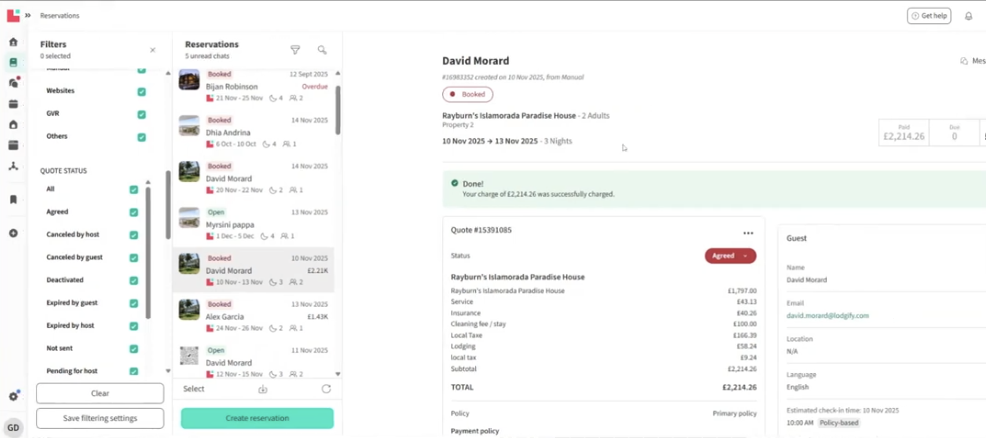
The main calendar and reservation screens are visually straightforward. Reservations, blocked dates and nightly rates are shown in the calendar, while individual bookings open into a detailed reservation view with guest, payment and pricing information.
For owners moving from Airbnb or another OTA-led setup, importing an existing listing should reduce the amount of information that needs to be entered manually. Hotels and B&Bs starting from scratch will need to decide whether to set up individual rooms as separate rentals or group similar rooms into room types.
I like this better now because it quietly establishes that Lodgify is relevant to hotels and B&Bs too, rather than making them feel like an afterthought.
Property Management System (PMS)
Lodgify’s PMS brings reservations, calendars, guest communication, payments and daily operational tasks into one system. Direct bookings and reservations from connected channels feed into the same calendar, with guest details, payment status and booking history attached to each reservation.
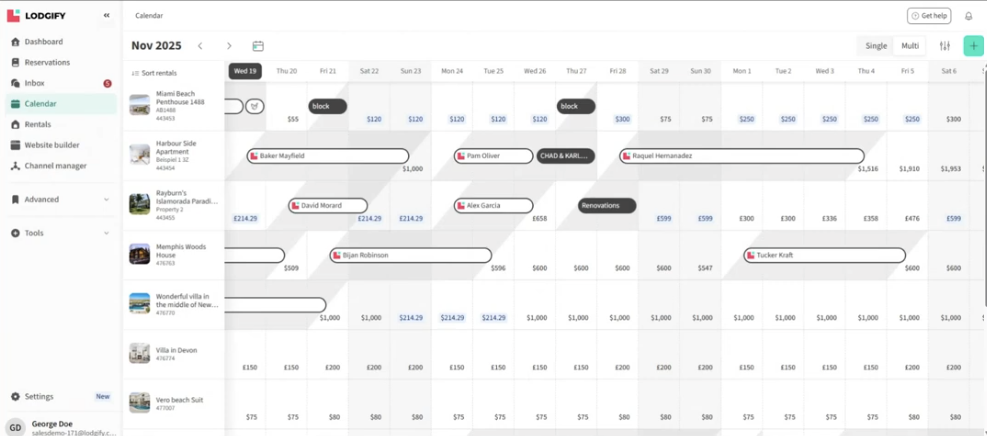
Staff can create manual bookings, block accommodation and change nightly rates directly from the calendar. Rate changes can then be pushed across connected channels, reducing the need to update each platform separately.
Lodgify also includes task management for cleaning and maintenance, automated guest messaging, team permissions and mobile access.
For small hotels and B&Bs, the important point is that Lodgify is not simply a booking engine. It provides a genuinely useful PMS layer for managing reservations, guest communication, payments, pricing and turnover between stays.
Booking Engine and Direct-Booking Website
Lodgify’s direct-booking setup combines a property website or embedded availability widget with a separate checkout stage for guest details and payment. Owners can either build their website with Lodgify or add Lodgify’s booking tools to an existing site.
Guests can check availability, choose their accommodation and pay online, with the reservation then feeding back into the Lodgify calendar.
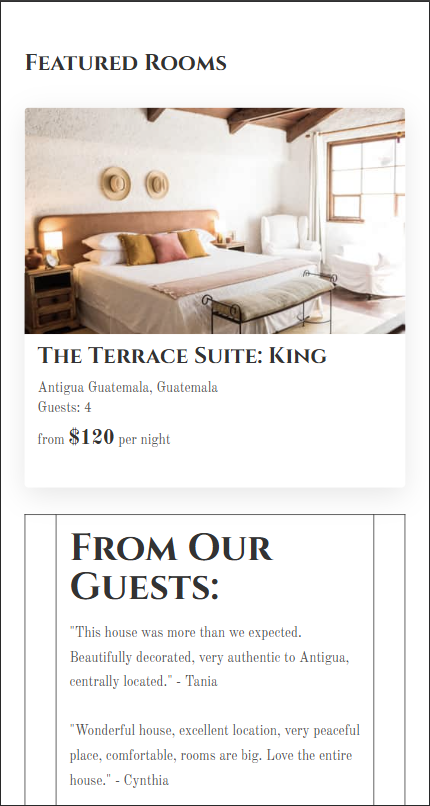
Mobile room presentation on a Lodgify-powered property website, with accommodation details and direct-booking pricing. Screenshot from the Lodgify website using Chrome DevTools device emulation (iPhone 12).
HSG observed one Lodgify implementation as part of its 42-property Hotel Booking Engine Study. The booking process was straightforward overall, with strong accommodation presentation, a persistent booking summary, clear progress and relatively little form-filling. Prices, taxes and payment information were also easy to follow.
In the implementation HSG tested, checkout opened in a second browser tab. This keeps the property website available if a guest wants to look back at the room or consider another option, but the trade-off is less obvious navigation on mobile. Usability research has found that mobile users do not always realise a new tab has opened, and switching back requires an extra browser action.
The checkout itself was stable and easy to use. One area that could have been clearer was cancellation information, which was less visible during checkout before personal details were requested, although the terms had been clearly set out on the property website.
Overall, the Lodgify booking flow felt simple and practical, especially for properties that want their own direct-booking website without building the whole system from scratch.
Channel Manager
Lodgify’s channel manager connects directly with Airbnb, Booking.com, Vrbo and Expedia, while additional channels can be linked through iCal. Rates, availability and reservations can then be managed from Lodgify rather than updated separately on each platform.
The direct API connections are the stronger part of the setup. Changes made in Lodgify can update rates and availability across the main channels, while new reservations feed back into the central calendar. Booking.com connections can also sync fees, taxes, guest details and payment information where enabled.
For smaller operators, this is one of Lodgify’s strongest features. It keeps the direct-booking website and the main OTAs working from the same availability, while still allowing channel-specific rate mark-ups where needed.
Guest Communications Tools
Lodgify includes a unified inbox for managing guest messages in one place, rather than checking each booking channel separately. Messages from connected channels can be handled alongside direct-booking enquiries, which is useful for smaller teams managing several properties.
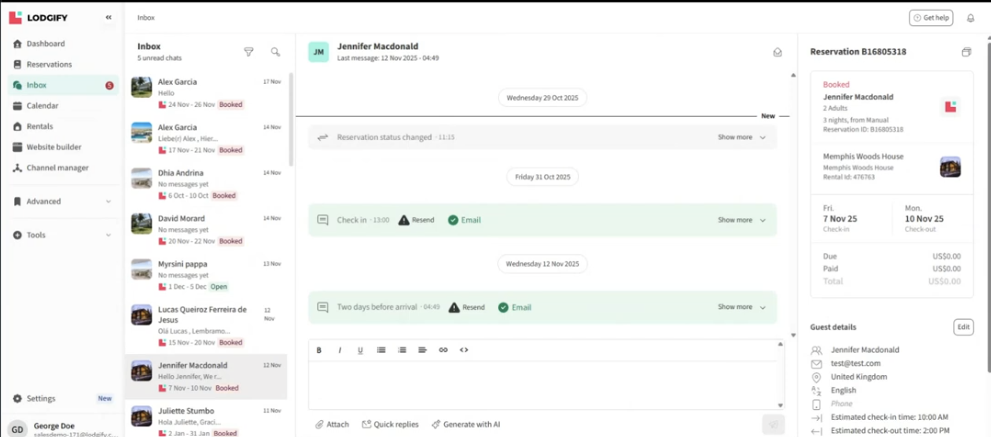
The platform also includes automated messaging, so properties can schedule confirmations, pre-arrival instructions, check-in details and post-stay follow-ups, with SMS available for some automated communications. Lodgify’s AI writing tools can help draft replies from short prompts or keywords — for example, asking it to respond about whether pets are allowed — which should make routine guest communication quicker.
For owner-managed properties, the appeal is fairly straightforward: fewer separate inboxes, less repeated typing and more consistent communication across the guest journey.
Payments & Invoicing
Lodgify supports online payments through its own Lodgify Payments service as well as gateways including Stripe, Braintree and Authorize.net. Depending on the setup, guests can pay by major cards and methods such as Apple Pay and Google Pay.
Payments are linked to the reservation, so owners can see what has been paid, what is still due and the relevant booking charges without keeping a separate record. Manual payment methods such as bank transfer can also be offered where preferred.
Lodgify also includes invoicing and payment reporting, which should cover the needs of many small operators that mainly want bookings and payments kept together in one system.
One thing worth noting is that Lodgify Payments is currently limited to US-based customers, so businesses elsewhere will generally use one of the supported external payment gateways instead.
Reporting & Insights
Lodgify provides reporting on revenue, occupancy, booking activity and channel performance. The Analytics area includes figures such as nights booked, average price per night, booking lead time, reservation length and cancellations.
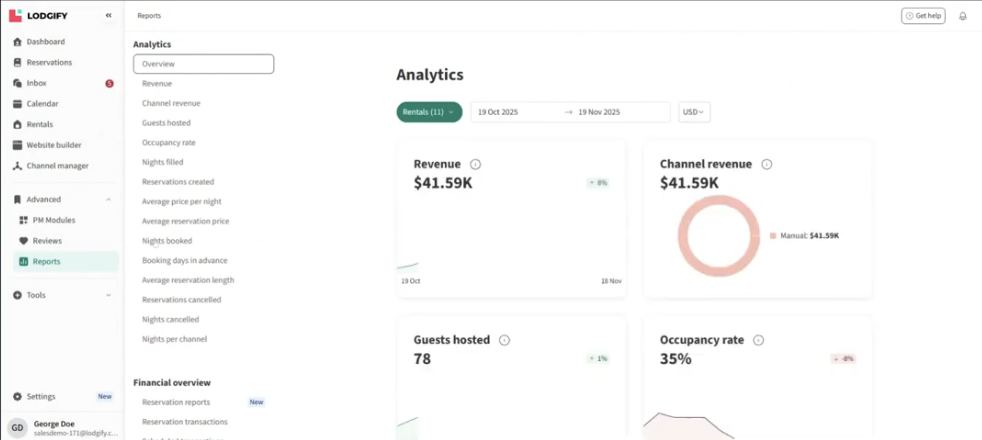
For owners managing several properties or rooms, reports can be filtered by rental and date range, making it easier to compare performance across the portfolio.
Lodgify also provides financial reporting through its property-management tools, including owner statements, booking income, fees, taxes and payments. For smaller operators, the main benefit is having operational and financial information linked to the same reservations rather than maintained in separate spreadsheets.
Customer Support & Training
Lodgify offers free personalised onboarding, with 1:1 help available for account setup, property creation, channel connections, payments and the direct-booking website. Most customers complete onboarding over a few sessions spread across one to two weeks.
After setup, customers have access to 24/7 support, alongside email, live chat and phone support depending on the plan. Lodgify also provides a Help Center, Learning Center and Lodgify Academy with guides, tutorials and training material.
For small operators without an IT team, the combination of guided onboarding and ongoing self-service material is a strong point. The support model is well suited to owners who may be learning the system as they go, rather than assuming previous property-management software experience.
Integrations
Lodgify has a fairly broad integration marketplace, particularly around the tools vacation-rental and small accommodation operators are likely to use day to day. Categories include booking channels, cleaning, dynamic pricing, guest experience, guest verification, keyless access, rental protection and business tools.
There are direct integrations with services such as Airbnb, Booking.com, Vrbo and Expedia, alongside operational tools including Turno and Breezeway, dynamic-pricing platforms such as PriceLabs and Beyond, smart-lock providers, Mailchimp and Google Analytics.
Zapier extends this further by linking Lodgify with more than 1,000 external apps, which is useful where a business already has its own accounting, marketing or workflow tools.
For most small operators, the integration range looks strong enough to cover the main areas around distribution, pricing, cleaning, guest communication and access control without requiring a very large enterprise-style app marketplace.
Strengths
Clear, scalable pricing
Lodgify’s pricing is unusually transparent. You can enter the number of rentals you manage, switch between monthly, yearly and two-year billing, and immediately see the available plans and prices. Pricing scales with the number of rentals, and the current plans run from Basic through to Ultimate.
Website builder for direct bookings
Lodgify includes a no-code website builder with templates that can be customised with your own colours, fonts, photos and content. The emphasis is on giving each property enough space to present its own character rather than forcing everything into a generic listing format.
Customers using their own externally registered domain keep ownership of that domain if they later leave Lodgify, although a Lodgify-built website itself remains hosted on the platform and cannot be exported.
Strong direct-booking setup
The website builder, booking engine and payment tools are designed to work together, so owners can take direct reservations without relying entirely on OTA listings. Lodgify also supports an embedded booking widget for businesses that already have their own website.
Useful upsells and add-ons
Lodgify allows properties to offer extras such as breakfast, additional beds, welcome packages, airport transfers or other paid services alongside a direct reservation. This is a practical strength for small properties that want to add services without needing a separate upselling system.
Good operational integration
The calendar, channel manager, reservations, payments, messaging and reporting all sit within the same system. Rates, availability and reservations can be managed centrally and synchronised across connected channels.
Automation without becoming overly complex
Lodgify combines automated messaging, task management, dynamic pricing, smart-lock support and guest tools with an interface that remains relatively approachable for a small operator.
Weaknesses
Room setup may require extra thought for hotels and B&Bs
Lodgify is built around rentals, so properties with several bookable rooms need to decide whether to list each room separately or group similar rooms into room types using the Bookable Units app. That flexibility is useful, but it may feel less immediately familiar than a hotel PMS where room types and physical rooms are built into the structure from the start.
Some useful features sit on higher plans
Lodgify’s pricing is transparent, but the lower tiers are deliberately limited. The Basic plan is aimed at one property and does not include the direct-booking website, while features such as automated messaging, owner reporting, advanced analytics and task management appear progressively on higher plans.
Checkout can feel slightly separate from the property website
In the implementation HSG tested, guests selected their accommodation on the property website before Lodgify opened the checkout on a separate URL in a new browser tab. The checkout itself was stable and straightforward, but switching between tabs is less obvious on mobile if a guest wants to look back at the room or reconsider their choice.
Website builder is not portable
Lodgify websites are hosted on Lodgify’s platform and cannot be exported or managed elsewhere after the subscription ends. If the domain is registered with an external provider, the owner keeps the domain and can point it to a new website, but the Lodgify-built site itself does not move with them.
Lodgify Payments is not available everywhere
Lodgify’s own payment service is currently limited to US-based customers, so businesses elsewhere will need to use one of its supported external payment gateways instead.
Alternatives to Lodgify
Lodgify is a strong fit for owner-managed rentals and smaller accommodation businesses that want direct bookings, a website and channel management in one system. Other platforms may suit businesses with a different operating model.
Hostaway
Hostaway is the closest alternative for vacation-rental and short-term-rental operators, but it is aimed more strongly at professional property managers and growing portfolios. Its PMS includes multi-calendar management, unified messaging, reporting, task management, owner statements and a direct-booking website, making it a better fit where managing multiple properties and owners is central to the business.
Little Hotelier
Little Hotelier is the more natural alternative for traditional small hotels, B&Bs and inns. It is organised around rooms, check-ins, room allocation, housekeeping and hotel distribution, while still including a booking engine, channel manager, payments and guest communication.
Cloudbeds
Cloudbeds is worth considering where a property needs a broader hotel-management platform with more operational depth, reporting and integrations. It is generally a larger and more complex system than Lodgify, and may make more sense for hotels planning to grow in operational complexity rather than primarily managing individual rentals.
Yanolja Cloud Solution / eZee Absolute
eZee Absolute is another hotel-focused alternative, combining PMS, channel management, booking engine and operational tools in a more conventional hotel setup. It is particularly worth considering for properties with a strong international distribution strategy, including businesses that rely on OTAs and regional booking channels across Asia and other markets where eZee/Yanolja has a substantial presence. It may suit hotels that need broader channel reach and more traditional hotel workflows rather than Lodgify’s stronger vacation-rental emphasis.
Pricing
Lodgify is unusually transparent about pricing. You can enter the number of properties you manage, choose your billing period and see the available plans and monthly cost immediately. Pricing increases with the number of properties rather than requiring a sales call for a basic quote.
For hotels and B&Bs, pricing depends on how rooms are structured. A 10-room property could be charged as 10 rentals if each room is unique and needs to be listed separately, or, for example, as three rentals if the rooms fall into three identical room types and are managed through Lodgify’s Bookable Units app for a small monthly fee.
At the time of writing, with one property (room, cabin, suite, etc.) and annual billing selected, the advertised prices were:
| Plan | Price | Best suite to |
|---|---|---|
| Basic | $14/month | One property needing channel management and a unified inbox |
| Starter | $26/month | Direct bookings, website builder and booking widget |
| Professional | $47/month | Automation, Google Vacation Rentals and dynamic pricing |
| Ultimate | $68/month | More advanced operations, owner reporting, task management and analytics |
Basic is limited to one property, while Starter is available for up to two. Professional and Ultimate are the more scalable options. All four currently advertise a 0% Lodgify booking fee.
The differences between the plans are fairly easy to understand. Starter adds the direct-booking website, booking widget, payments and personalised onboarding. Professional adds features such as automated messaging, Google Vacation Rentals and dynamic pricing, while Ultimate adds task management, check-in/check-out automation, owner statements, guest invoices, advanced analytics and priority support.
Room setup considerations for hotels and B&Bs
Lodgify is built around rentals, so hotel-style room inventory needs to be structured carefully. For properties where individual rooms have distinct identities, listing each room separately may work well. Hotels and B&Bs with identical or very similar rooms are more likely to benefit from grouping them into room types through the Bookable Units app. That flexibility is useful and can have affect the overall price, although it requires using Lodgify’s rental structure to recreate the room-type setup that hotel PMSs usually provide as a standard part of the system.
Lodgify also offers a 7-day free trial without requiring a credit card, and customers can switch or cancel plans. Annual customers retain access until the end of the paid billing period.
Sign up for a 7-day free trial ->
Verdict: Is Lodgify Worth It?
Lodgify is a strong option for independent accommodation businesses that want direct bookings, channel management and day-to-day reservation tools in one relatively approachable system.
Its biggest strengths are the transparent pricing, website builder, booking engine, channel manager and practical automation features. The direct-booking side is particularly well developed, with flexible website options, online payments and useful upsells for extras and add-on services.
For vacation rentals, cabins, cottages and other self-catering accommodation, the fit is especially clear. Small hotels, B&Bs and guesthouses should also find Lodgify worth considering, particularly where the operation is relatively straightforward and the property is comfortable structuring rooms either as individual rentals or grouped room types through the Bookable Units app.
The main limitations are fairly modest. Some of the more useful automation, reporting and operational features sit on higher plans, Lodgify Payments is currently limited to US-based customers, and Lodgify-built websites cannot be exported or managed outside the platform after a subscription ends.
Overall, Lodgify combines strong direct-booking tools with enough property-management depth to make it much more than a website or booking engine alone.
Best suited for:
- Vacation rentals, cottages, cabins and apartments
- Small hotels, B&Bs and guesthouses with relatively straightforward room, rate and add-on structures
- Owner-managed accommodation businesses
- Small operators wanting their own direct-booking website
- Properties wanting channel management and guest communication in one system
- Businesses looking to reduce reliance on OTAs without building a separate website and booking setup from scratch
Less suitable for:
- Properties that require a very large specialist integration ecosystem
- Operators outside the US hoping to use Lodgify’s own payment service
- Hotels that prefer a conventional hotel PMS structure where room types and individual rooms are built into the system from the outset
- Businesses that need a website they can export and continue managing independently after leaving the platform
⭐ Ease of Use: 5/5
⭐ Mobile Optimization: 4/5
⭐ Reporting: 4/5
⭐ Value for Money: 5/5
Looking for more options?
See all our hotel booking system reviews and comparisons in our Hotel Booking System Reviews hub.
If you’re still evaluating your options, our guide How to Choose the Right Hotel Management System breaks down the process step by step.