
Table of Contents
Running a small hotel or B&B comes with plenty of jargon. You’ve probably heard terms like PMS, booking engine, and channel manager — often used interchangeably by software providers. But here’s the truth: they aren’t the same thing, and knowing the difference can save you both money and stress.
A PMS manages your hotel’s operations behind the scenes, a booking engine drives direct reservations through your website, and a channel manager keeps your availability synced across OTAs like Booking.com or Expedia.
In this guide, we’ll break down exactly what each tool does, how they work together, and — most importantly — which combination small hotels and B&Bs really need in 2025.
PMS (Property Management System)
Definition: The central “back office” tool — handles reservations, check-in/out, housekeeping, billing.
Key Features:
- Calendar & room status management.
- Guest profiles and history.
- Housekeeping coordination.
- Reporting.
Pros: Streamlines daily operations, prevents errors.
Cons: Some PMSs don’t include strong booking or OTA features.
Booking Engine
Definition: The online “front door” where guests book directly on your website.
Key Features:
- Real-time availability and pricing.
- Payment processing.
- Mobile-friendly booking flow.
Pros: Keeps 100% of the revenue, builds guest loyalty.
Cons: Only works if guests find and trust your site.
Channel Manager
Definition: The “bridge” that syncs inventory across OTAs (Booking.com, Expedia, Airbnb) and your website.
Key Features:
- Automatic availability updates.
- Rate parity controls.
- Multi-channel reporting.
Pros: Prevents double bookings, saves admin time.
Cons: Usually requires integration with PMS or booking engine.
💬 Real Experience
I’ve lived the nightmare of double-bookings — two guests arriving for the same room, and we had to awkwardly rehouse one of them. A channel manager can’t guarantee it will never happen, but it dramatically reduces the risk. And when prevention means avoiding chaos in peak season, that reduction is worth its weight in gold.
How They Work Together
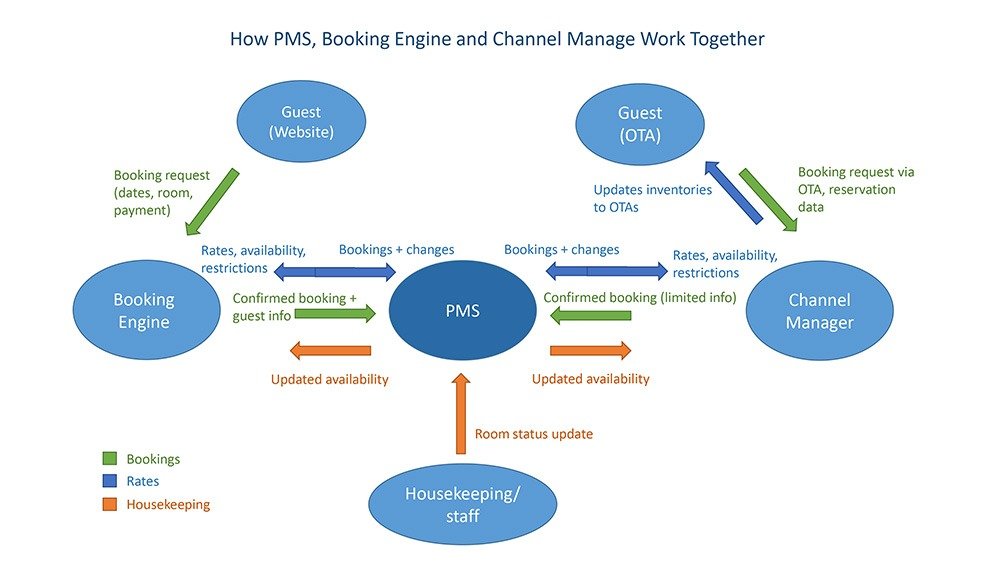
Each system has a different role, but they’re most powerful when connected:
- PMS = the back office.
This is the “control center” where all reservations, guest profiles, housekeeping tasks, and billing come together. Staff use the PMS daily to know who’s arriving, which rooms are ready, and what services guests have booked. - Booking Engine = the direct sales channel.
This is the “Book Now” button on your website. Guests use it to check availability, see your rates, and confirm a reservation instantly. Every direct booking flows into the PMS automatically. - Channel Manager = the distribution hub.
This connects your rooms to OTAs like Booking.com, Expedia, or Airbnb. When a guest books through an OTA, the channel manager pushes that reservation into the PMS, while also updating availability everywhere else so you don’t oversell.
When all three work together, the flow looks like this:
- Guests book through either your website or OTAs.
- The PMS collects every booking and keeps your calendar updated.
- Availability and rates sync both ways between the PMS, booking engine, and OTAs through the channel manager.
- Housekeeping updates in the PMS free up rooms instantly for resale.
Modern systems often combine these functions into one platform. Tools like Cloudbeds or Little Hotelier give you a PMS, booking engine, and channel manager in a single package, so you don’t have to juggle multiple vendors.
While integrated platforms save time and reduce hassle, they also handle a lot of sensitive guest information. Learn more about how modern booking systems protect that data.
For strategies to reduce dependence on OTAs and reach more guests directly, check out Beyond OTAs: How to Diversify Your Booking Channels in 2025.
Cost-conscious operators may want to check out how to turn booking engine visitors into direct bookings without ads.
What Small Hotels Really Need
Very Small B&B (Under 10 Rooms)
A booking engine + channel manager may be enough. This setup keeps commissions low while ensuring your rooms are visible across OTAs, without the added complexity (and cost) of a full PMS.
For Small Hotels (10–20 Rooms): A Decision Point
At this size, you’re right on the edge between “simple tools” and “full system.” Here’s a quick way to decide what makes sense:
- Stick with a booking engine + channel manager if…
- You run the property mostly yourself or with a small team.
- Guest services are straightforward (room + breakfast, nothing complex).
- You’re comfortable handling housekeeping schedules, billing, and guest records manually.
- Invest in a PMS (plus booking engine + channel manager) if…
- You have multiple staff members handling reservations, check-ins, or housekeeping.
- You want more structure around guest history, billing, or upsells.
- Occupancy is high enough that manual admin feels overwhelming.
👉 The difference often comes down to time vs cost: under 10 rooms, manual admin is usually manageable; over 20 rooms, it becomes unmanageable. In between, it’s a matter of how much your time is worth.
Boutique Hotel (20–100 Rooms)
At this scale, all three are usually essential — and ideally integrated in a single platform. Manual processes become too risky and time-consuming once you’re juggling larger volumes of guests and staff.
Growth-Focused Property
If you plan to expand, an all-in-one system is the best option. It avoids the headaches of juggling multiple vendors and ensures your tech stack can grow with you.
Choosing the Right System
Not every small hotel has the same needs — or the same budget. When it’s time to choose a booking system, keep these factors in mind:
- Integrated platform vs. standalone tools
Some vendors (like Cloudbeds or Little Hotelier) bundle PMS, booking engine, and channel manager into one solution. That’s convenient, but often more expensive. If your property only has a handful of rooms, you might save money by combining a basic PMS with a standalone booking engine. - Budget considerations
Costs scale with features and room count. A 6-room B&B doesn’t need the same functionality as a 70-room boutique hotel. Be realistic about what you’ll actually use — paying for advanced reporting or revenue management modules only makes sense if you’ll act on the data. - Free trials and demos
Nearly all reputable vendors offer a free trial or at least a guided demo. Take advantage of them. Testing the interface is the best way to know if it feels intuitive for you and your staff.
When you’re ready to compare systems side by side, check out How to Choose the Right Hotel Management System in 2025 — it includes practical evaluation tips and a free downloadable workbook.
💡 Tip: Involve the front-desk or housekeeping team in demos — they’re the ones who’ll use the system daily, and their feedback can save you from picking a tool that looks great on paper but frustrates in practice.
🔗 Why Integration Matters
When these systems don’t “talk” to each other, small hotels face real problems:
- Double-bookings: Two guests reserve the same room, and staff scramble to rehouse one.
- Outdated rates: Prices on OTAs don’t match your website, making you look unreliable.
- Lost revenue: A clean, available room sits empty because the PMS wasn’t updated in time.
An integrated PMS + booking engine + channel manager prevents these headaches and keeps your operation smooth.
👉 For detailed comparisons of leading providers, check out our full guide: Best Booking Systems for Small Hotels & B&Bs in 2025.
Conclusion
PMS, booking engines, and channel managers each solve different problems — but they’re most powerful when connected. A PMS keeps your back office organized, a booking engine drives direct reservations, and a channel manager prevents costly double-bookings on OTAs.
For most small hotels and B&Bs, an all-in-one system is the simplest, most cost-effective choice. With one login, you can manage reservations, sync inventory, and keep your guests happy without juggling multiple vendors.
Frequently Asked Questions
What does a PMS do in a hotel?
A PMS (Property Management System) is the “back office” software that handles reservations, check-in/check-out, billing, housekeeping coordination, and guest records. For small hotels, it saves time by keeping everything in one place and reducing manual errors.
Do I need both a booking engine and a channel manager?
Yes, in most cases. A booking engine lets guests book directly on your website, while a channel manager syncs your availability with OTAs like Booking.com and Expedia. Together, they help you attract guests directly while avoiding double bookings across platforms.
Can a PMS replace a booking engine?
Not usually. A PMS is focused on managing operations inside the hotel. Some modern PMS solutions include a booking engine module, but if not, you’ll need a dedicated booking engine to accept reservations directly from your website.
What is the difference between a booking engine and a channel manager?
A booking engine processes reservations on your own website. A channel manager distributes your rooms to OTAs and keeps availability synced across all channels. They solve different problems but are most effective when integrated together.